If someone were to ask you where you fit politically, would you be inclined to say something like, “I lean left” or “I’m far right”? If they asked you how you fit in where you live, is it possible you might say, “I’m definitely blue living in a red state” (or vice versa)?
What does it mean, really, to live in a “red state” or a “blue county”? Are political and ideological beliefs—and by association, the people that carry those beliefs—really so distinct that they can be narrowed into one of two very distinct colors? If you don’t fit the perfect mold of republican red or democratic blue, do you inherently become purple, the only other logical color option, some blending of blue and red?
The idea seems silly, really, when we think of the the obvious complexity of the human mind amid the infiniate combinations of culture, ethnicity, upbringing, education, religion, and a host of other factors that actually shape individuals’ worldviews. The political spectrum—an imaginary line that places dark blue at the far left and dark red at the far right—is functionally useful for having conversations but also a fundamentally wrong (and increasingly dangerous) way to simplify the diversity of human thought into two polarized groups.
As absurd as the red-blue imagery seems for simplifying people and the regions in which they live, it has become an all-to-common metaphor for describing ourselves. The very simplicity of a linear spectrum and a polarized two-color model inherently limits a person to leaning red or blue, suggesting they can’t really have a complex, multifaced worldview that pulls from many diverse combinations of beliefs in economics, foreign policy, religion, immigration, healthcare, social issues, education, and so on.
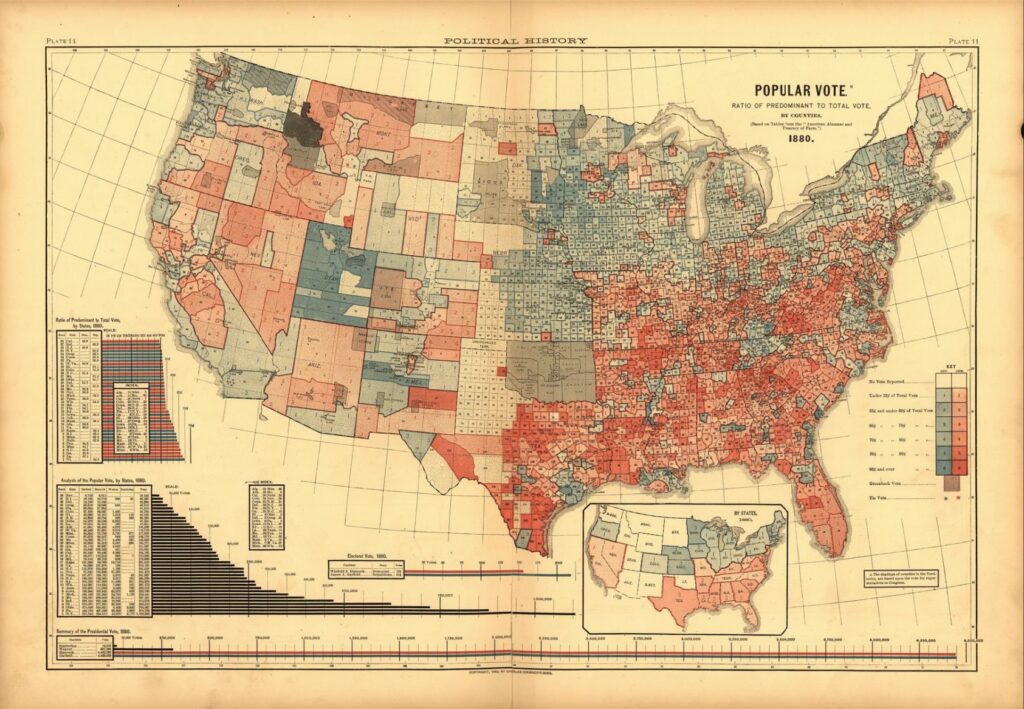
It’s hard to pinpoint a single event that has led U.S. citizens to talking about themselves in this way; it’s been a progressive evolution that has evolved as political parties rose and fell throughout the 19th and early 20th centuries. But we can look to the visualization of American votes in the 1880 election, depicted in the map above, as an early example for how visualizing America changed the conversation about how we see ourselves.
In the map, only two colors are presented (red is for democratic votes and blue is for republican, opposite of what we use today). While shades of colors represent higher or lower percentages of votes, there is a clear—and problematic—visual distinction. Even in counties that are a near even 50/50 split, they are represented as either red or blue. The hard lines between colors create an absurdly distinct separation, particularly visible in the borders btween Utah, Idaho, Arizona, and Nevada, suggesting an immediate and stark difference in political views for hundreds of miles along invisible borders.
Political maps like these have evolved over time. Prior to the 21st century, news outlets used many different colors, including organge and yellow, among other visual signifiers, to visualize each party. It wasn’t until the 2000 election, between Bush and Gore, that news outlets began harmonizing—and thus universally concretizing—the use of blue for democrat and red for republican.
Today, that distinct imagery is so fastened into the mind of most Americans that it’s hard not to define ourselves as either one or the other. Sadly, it’s a reductionist way of thinking about diversity of thought and the complex, richness of the people of our nation. Worse, the visualizations we see today, which perpetuate this bifurcation of people by political color, is only serving to assist in the polarization.
Are we not more diverse than two parties? Can we not be represented by more than two colors? Should we not stop thinking of ourselves, our counties, and our states, in only two divergent ideologies? Are we limiting our ability to think in third-, fourth-, and fifth- party views because only two seem possible?
Visual depictions like these matter. Sure, they’re easier to talk about and to post on social media or display on TV during election cycles, but are they also simplifying who we really are while also unnecessarily creating enemies, through visual separation, amongst ourselves?