
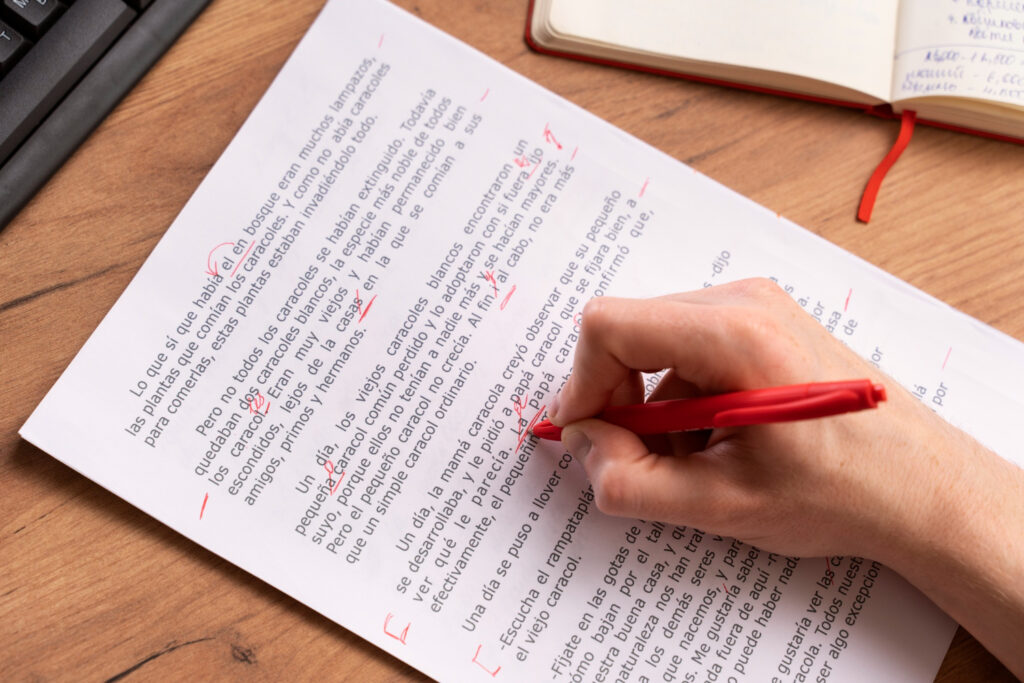
Editing for style means refining your writing to make it clearer, more engaging, and more polished. While grammar and spelling edits ensure correctness, style edits shape how your writing feels and flows. Strong editing enhances clarity, consistency, and impact, helping you communicate your ideas more effectively.
This page addressed the follows areas of editing to improve style:
- What Is Editing for Style?
- How Editing Affects Writing Style
- Best Practices for Editing Writing Style
- Read Your Work Aloud
- Cut Unnecessary Words
- Strengthen Sentence Structure
- Use Active Voice Instead of Passive Voice
- Maintain Consistency in Tone and Word Choice
- Improve Flow with Transitions
- Replace Weak Words with Stronger Alternatives
- Eliminate Repetitive Phrasing
- Get Feedback from Others
1. What Is Editing for Style?
Editing for style means improving the way your writing sounds and reads. It goes beyond fixing typos—it’s about making sure your words flow smoothly, your tone stays consistent, and your sentences are effective.
A well-edited piece feels effortless to read, while an unedited one may seem clunky, wordy, or awkward.
Example of writing before and after a style edit:
Before (clunky and unclear):
In order to make sure that the team meets the deadline, it is important that communication is effective and that everyone is aware of their specific roles.
After (concise and clear):
✅ To meet the deadline, the team must communicate effectively and understand their roles.
Editing for style makes your writing sharper, more concise, and more engaging.
2. How Editing Affects Writing Style
Editing shapes your writing style by making it more:
- Clear – Eliminates ambiguity and unnecessary complexity.
- Concise – Reduces wordiness and redundancy.
- Engaging – Strengthens word choice and sentence flow.
- Consistent – Keeps tone, voice, and formatting uniform.
Example of how editing affects style:
Before (wordy and indirect):
It is important to note that the changes that have been implemented in the new policy are meant to make the process more efficient.
After (concise and direct):
✅ The new policy changes improve efficiency.
By cutting filler words and restructuring sentences, you make your writing more impactful.
3. Best Practices for Editing Writing Style
Read Your Work Aloud
Reading aloud helps you catch awkward phrasing, choppy sentences, and inconsistencies. If something sounds off when spoken, it probably needs revision.
Example:
Before (awkward phrasing):
The reason why we chose this method is because it allowed for a better way to collect data.
After (natural phrasing):
✅ We chose this method because it improved data collection.
When you read aloud, unnecessary words and unnatural structures become easier to spot.
Cut Unnecessary Words
Concise writing is stronger writing. Remove extra words that don’t add meaning.
Common unnecessary words and their replacements:
- “In order to” → “To”
- “Due to the fact that” → “Because”
- “At this point in time” → “Now”
Example:
Before (wordy):
She was of the opinion that the meeting should be postponed until later.
After (concise):
✅ She thought the meeting should be postponed.
Strengthen Sentence Structure
Avoid overly complex or choppy sentences. Aim for smooth, balanced sentence structures.
Example:
Before (choppy):
The study was conducted. The data was collected. The findings were analyzed.
After (smooth):
✅ The study collected data and analyzed the findings.
Use Active Voice Instead of Passive Voice
Active voice makes writing more direct and engaging.
Example:
Before (passive voice):
The decision to approve the project was made by the committee.
After (active voice):
✅ The committee approved the project.
Passive voice isn’t always wrong, but active voice is usually clearer and more dynamic.
Maintain Consistency in Tone and Word Choice
If you start with a formal tone, don’t suddenly switch to a casual one. Keep terminology consistent, especially in professional or academic writing.
Example of inconsistent tone:
Before:
The company’s financial projections indicate significant growth. Plus, it’s looking like a pretty solid year ahead!
After (consistent tone):
✅ The company’s financial projections indicate significant growth, suggesting a strong year ahead.
Improve Flow with Transitions
Transitions help connect ideas smoothly, making writing easier to follow.
Example:
Before (abrupt shift):
The new policy reduced costs. Employee satisfaction dropped.
After (better flow):
✅ While the new policy reduced costs, it also led to a decline in employee satisfaction.
Common transition words:
- Cause and effect: Therefore, as a result, consequently
- Contrast: However, on the other hand, nevertheless
- Addition: Furthermore, in addition, moreover
Replace Weak Words with Stronger Alternatives
Vague words weaken writing. Replace them with specific, powerful alternatives.
Examples:
➡️ Really big → ✅ Enormous
➡️ Very interesting → ✅ Fascinating
➡️ A lot of work → ✅ Extensive effort
Before (weak word choice):
She was really happy about the promotion.
After (stronger word choice):
✅ She was thrilled about the promotion.
Eliminate Repetitive Phrasing
Repetitive writing wastes space and weakens impact.
Example:
Before (repetitive):
The plan is an essential necessity that we absolutely need to implement.
After (concise):
✅ We must implement this essential plan.
Get Feedback from Others
A fresh set of eyes can catch inconsistencies you might miss. Ask a colleague, friend, or editor to review your writing.
Example of overlooked inconsistency:
Before:
In this guide, we’ll explain the process. Next, I will provide examples.
After (consistent):
✅ In this guide, we’ll explain the process. Next, we’ll provide examples.
An outside reader can help spot shifts in tone, unclear phrasing, or inconsistencies.
*Content on this page was curated and edited by expert humans with the creative assistance of AI.