
Skip to content
The Comm Spot The Comm Spot

It's All About Communication

  • HOME
  • ABOUT
    • Meet the Creator: Curtis Newbold, PhD
    • Hire Curtis
    • Publish with Us
    • Contact
    • Privacy Notice
  • COMM-BASICS
    • Glossary
    • Citation & Style Guides
      • AP Style (Journalism)
        • AP Style Overview
        • AP Style Guidelines
        • Media Ethics – SPJ Code of Ethics
        • Elements of Newsworthiness
      • APA Style
        • APA Format – Overview
        • APA - References Guidelines
        • APA - In-text Citations
        • APA - Citing Authors
        • APA - Audiovisual Media
        • APA - Books
        • APA - Digital Sources
        • APA - Events & Interactions
        • APA - Periodicals
        • APA - Print Sources (other than books)
      • Chicago Style
        • Chicago – Overview
        • Chicago - Author-Date System
        • Chicago - Notes-Bibliography System
        • Chicago - In-text Citations
        • Chicago Style - Citing Authors
        • Chicago - Audiovisual Media
        • Chicago - Books
        • Chicago - Digital Sources
        • Chicago - Events and Interactions
        • Chicago - Citing Periodicals
        • Chicago - Print Sources (other than books)
      • MLA Style
        • MLA Overview
        • MLA Works Cited Pages
        • MLA In-text Citations
        • MLA – Authors
        • MLA – Audiovisual Media
        • MLA – Books
        • MLA – Digital Sources
        • MLA – Events & Interactions
        • MLA – Periodicals
        • MLA – Print Sources (other than books)
    • Rhetoric
      • Overview of Rhetoric
      • Rhetorical Appeals (Rhetorical Triangle)
      • Branches of Oratory
      • Canons of Rhetoric
      • Rhetorical Devices
      • Kairos
      • Topos
      • Key Figures in Rhetoric
    • Research Methods
      • Case Studies
      • Competitor Analysis
      • Content Analysis
      • Discourse Analysis
      • Ethnography
      • Focus Groups
      • Observation Research
      • S.W.O.T. Analysis
      • Secondary Research
      • Surveys
      • Target Market Analysis
      • Usability Testing
      • Visual Analysis
    • Theories
    • Thinkers
  • COMM-SUBJECTS
    • Interpersonal Communication
      • Active Listening
      • Body Language
      • Conflict Management
      • Emotional Intelligence
        • Emotional Intelligence Overview
        • Self-Awareness
        • Self-Regulation
        • Motivation
        • Empathy
        • Social Skills
        • Emotional Intelligence Resources
      • Feedback
      • Negotiation
        • Overview of Negotiation
        • Negotiation Skills
        • Negotiation Strategies & Techniques
        • Stages of Negotiation
        • Common Negotiation Scenarios
        • Negotiation Case Studies & Examples
        • Negotiation Tools & Resources
        • Negotiation FAQ
    • Journalism
    • Public Speaking
      • General Guidelines
      • Overcoming Fear
      • Speech Writing and Organization
      • Delivery Techniques
      • Body Language
      • Audience Engagement
      • Storytelling
      • Designing Slides
      • P.O.W.E.R.F.U.L. Presentation Method
    • Strategic Communication
      • Business & Org Comm
        • Definition & History
        • Org Comm Theories
        • Business Documents
        • Change Management
        • Employee Relations
        • Employment Communication
        • Group & Team Communication
        • Leadership Communication
        • Power, Identity, & Ethics at Work
        • Project Management
      • Integrated Marketing Comm
        • Definition of IMC
        • Core Principles of IMC
        • IMC Planning
        • Audience Segmentation
        • Marketing Channels
        • Message Strategies
        • Campaign Measurement & Evaluation
        • Trends & Innovations in IMC
        • Challenges & Pitfalls in IMC
        • Careers & Roles in IMC
      • Public Relations
        • Foundations in PR
        • Strategic Practice
        • Tools & Tactics
        • Research & Analysis
        • Professional Development
      • Case Studies in Strat Comm
    • Technical & Scientific Communication
    • Visual Communication
      • Data Visualization
      • Information Design
      • Photography
      • Web Design
    • Written Communication
      • Writing Process
      • Organizational Methods
        • Five Paragraph Essay
        • Hourglass Method of Writing
        • IMRaD Format (Science)
        • Indirect Method (Bad News)
        • Inverted Pyramid (Journalism)
        • Martini Glass
        • Narrative Format
        • Proposal Format
        • Rogerian Method
        • Toulmin Method
      • Plain Language
        • Audience (Plain Language)
        • Organization (Plain Language)
        • Conversation (Plain Language)
        • Simplicity (Plain Language)
        • Word Choice (Plain Language)
        • Sentence Structure (Plain Language)
        • Design (Plain Language)
      • Punctuation
        • Apostrophes
        • Brackets
        • Colons
        • Commas
        • Ellipses
        • Em Dashes
        • En Dashes
        • Exclamation Marks
        • Hyphens
        • Parentheses
        • Periods
        • Question Marks
        • Quotation Marks
        • Semicolons
      • Style
        • Clarity
        • Conciseness
        • Consistency
        • Editing
        • Flow
        • Rhetorical Devices
        • Sentence Structure
        • Storytelling
        • Tone
        • Voice
        • Word Choice
  • RESOURCES
    • Teaching Resources
      • Assignments & Activities
      • Instructional Design
      • Pedagogies
  • BLOGS
    • The Spotlight Blog
    • Comm Sparks
  • SHOP
    • Cart
    • Checkout
0
The Comm Spot
The Comm Spot

It's All About Communication

Em Dashes

Home >COMM-Subjects >Written Communication >Punctuation >Em Dashes

What Are Em Dashes?

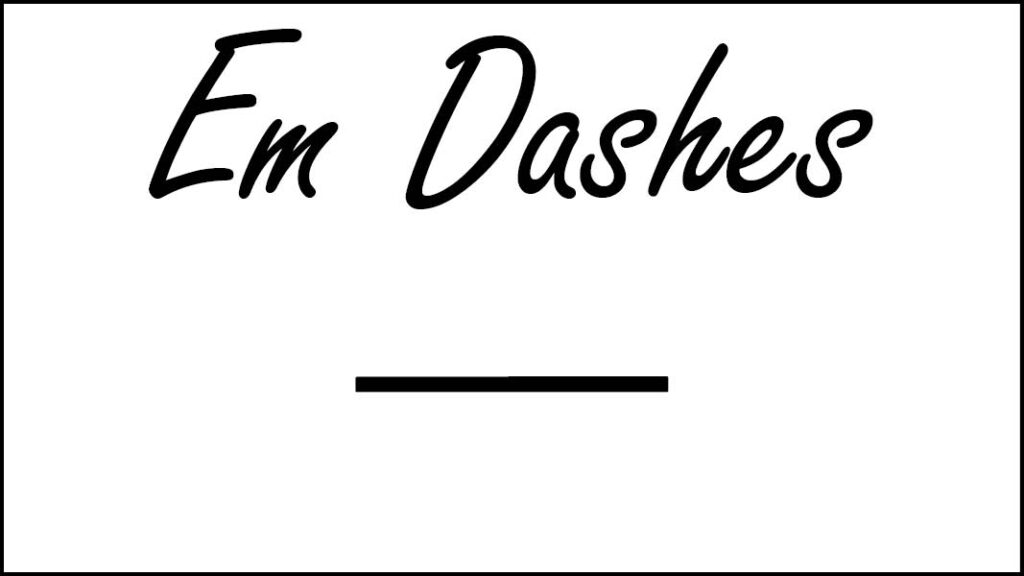
The em dash (—) is one of the most versatile punctuation marks in English writing. It can be used for emphasis, to add detail, or to indicate an interruption in thought. Unlike commas, parentheses, or colons, em dashes provide a stronger break in a sentence while maintaining a natural flow.

An em dash (—) is a long dash (approximately the width of the letter “m”) that is used to create emphasis, insert additional information, or signal an abrupt shift in thought. Unlike hyphens (-) and en dashes (–), the em dash is used primarily within sentences rather than for word formation or number ranges.

Examples:

  1. “She had one goal—winning at any cost.”
  2. “The trip—which had been planned for months—was suddenly canceled.”

Learn Next: How to Use En Dashes


The Three Ways to Use Em Dashes

The em dash is commonly used for three different purposes, each of which are explained below with examples:

  1. Interject a Main Clause to Add Emphasis
  2. Clarify with Added Detail
  3. Suggest an Interruption in Thought or Change in Direction

1. Interject a Main Clause to Add Emphasis

Em dashes can be used in place of commas or parentheses to set off an important part of a sentence. This technique draws attention to the inserted phrase, making it more striking or dramatic.

Examples:

  1. “The storm—one of the worst in decades—knocked out power across the city.”
  2. “His words were clear—this was not up for debate.”

What NOT to Do:

  • “The storm, one of the worst in decades—knocked out power across the city.” (Using both a comma and an em dash creates inconsistency.)

2. Clarify with Added Detail

Em dashes can replace colons or parentheses to provide additional information without disrupting the sentence’s rhythm.

Examples:

  1. “Three things mattered most—honesty, loyalty, and perseverance.”
  2. “He finally met his idol—an artist he had admired since childhood.”

What NOT to Do:

  • “Three things mattered most— honesty, loyalty and perseverance.” (Avoid unnecessary spaces after the em dash.)

3. Suggest an Interruption in Thought or Change in Direction

In dialogue or narrative writing, em dashes can signal an abrupt break in thought, hesitation, or an interruption.

Examples:

  1. “I was just about to tell you—wait, did you hear that?”
  2. “She started to explain—but he had already left the room.”

What NOT to Do:

  • “I was thinking about— um— going to the store.” (For minor hesitations, an ellipsis (…) is usually more appropriate.)

Rhetorical Use of Em Dashes

Beyond their technical functions, em dashes can be used rhetorically to control pacing, build suspense, or create emphasis. They allow writers to mimic natural speech patterns, making prose feel more fluid and engaging.

Examples:

  1. “I knew exactly what I had to do—but I just couldn’t move.” (Creates suspense)
  2. “He was everything she had ever wanted—kind, smart, adventurous.” (Adds emphasis and rhythm)

What NOT to Do:

  • “She was—tired.” (This creates an awkward pause without a clear reason.)

*Content on this page was curated and edited by expert humans with the creative assistance of AI.

  • facebook
  • instagram
  • linkedin

DON'T MISS ANY SPOT-ON TIPS!

We don't spam! You'll only get emails when we post something awesome.
You can unsubscribe at any time.

Check your inbox or spam folder to confirm your subscription.

©2025 | The Comm Spot | By Newbold Communication & Design