

The field of public relations has evolved from ancient rhetorical strategies to a highly specialized and strategic communication discipline. Throughout history, influential events, individuals, and societal shifts have shaped how organizations and individuals communicate with the public. Understanding PR’s history provides important context for its modern applications and continued transformation.
Key Events in Public Relations
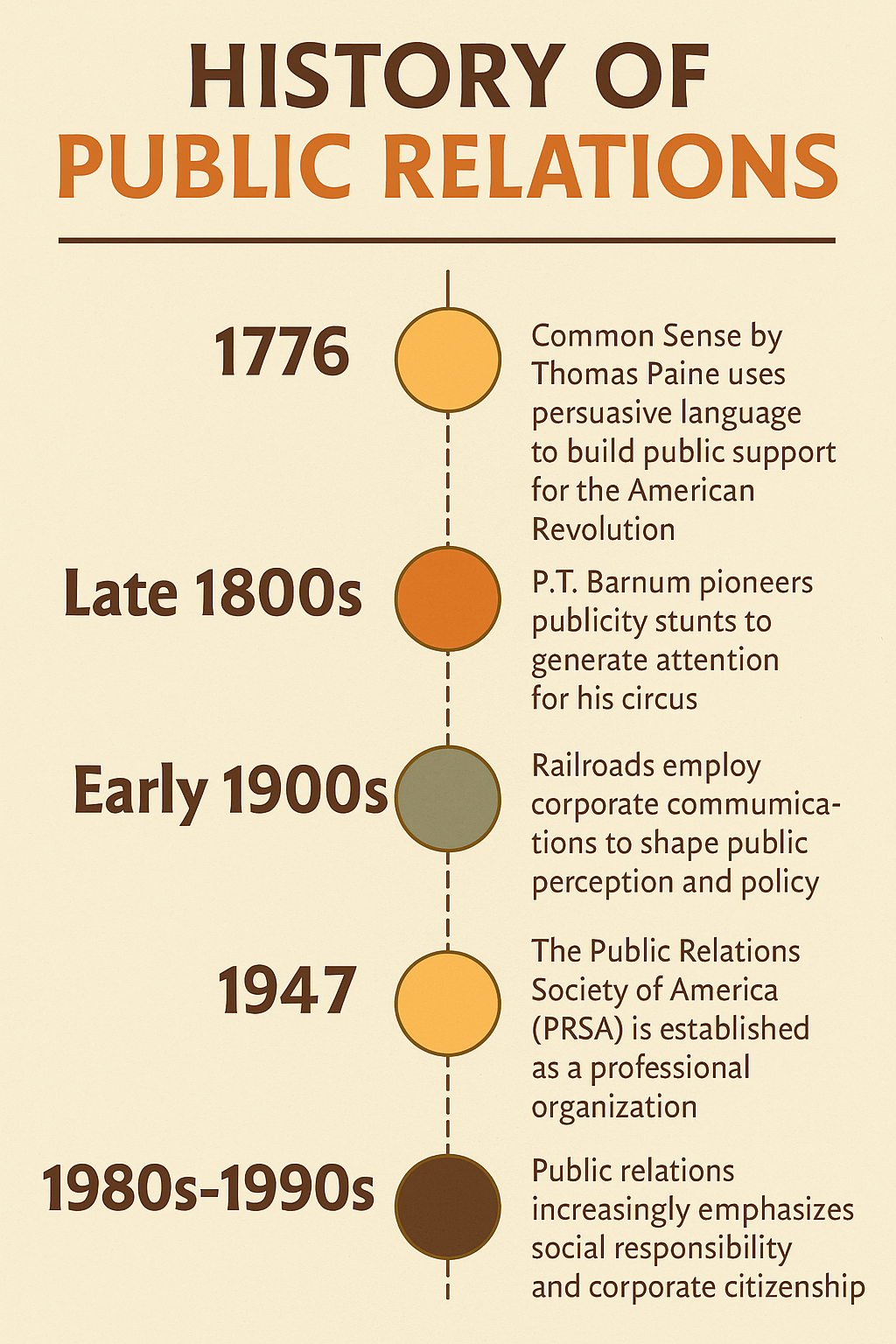
Thomas Paine, Common Sense: One of the earliest examples of mass persuasive communication can be found in Thomas Paine’s 1776 pamphlet Common Sense. Written to rally support for American independence, Common Sense framed the British monarchy as oppressive and unjust, presenting arguments in clear, emotionally resonant language. The pamphlet’s success—over 500,000 copies circulated in its first year—demonstrated the power of media to influence public sentiment and political action, laying a philosophical and practical foundation for public relations in a democratic society.
PT Barnum, Press Agentry: In the mid-1800s, P.T. Barnum revolutionized publicity with his flair for promotion. Barnum used dramatic, exaggerated messaging and stunts to draw attention to his American Museum and traveling circus. While many of his tactics were based on deception, such as advertising “The Feejee Mermaid” or “General Tom Thumb,” they showcased the power of creating buzz, controlling narratives, and building public curiosity. Barnum is often credited as the prototype of the modern press agent, blending entertainment and persuasion in a way that foreshadowed contemporary PR tactics.
American Railroads, Media Relations: Another milestone in the 19th century was the use of public relations in the expansion of the American railroad industry. As railroads extended across the country, companies faced public skepticism, safety concerns, and regulatory scrutiny. To counter this, they employed press agents to generate favorable media coverage, distribute pamphlets, and build public goodwill. These efforts were early examples of corporate PR, focused on shaping perception, gaining public trust, and influencing public policy.
Committee on Public Information, Public Awareness & Education: During World War I, the U.S. government created the Committee on Public Information (CPI), also known as the Creel Committee. Headed by journalist George Creel, this initiative used films, posters, news stories, and public speakers to rally public support for the war. It marked the first major government-run public relations campaign, demonstrating how mass media and messaging could mobilize an entire population—and how PR could be used for national and ideological influence.
PRSA, Ethical Standards: In 1948, the establishment of the Public Relations Society of America (PRSA) marked a major step in the professionalization of the field. By the 1950s, PRSA had begun to set ethical standards, promote accreditation, and provide professional development opportunities for practitioners across the country. Its founding helped legitimize PR as a distinct discipline, moving it beyond publicity and aligning it with corporate strategy, management communication, and ethical accountability. The PRSA’s Code of Ethics, adopted in the 1950s and continually updated, reinforced a growing expectation that PR professionals serve the public interest and operate with integrity.
CSR, Corporate Values: By the 1980s and 1990s, public relations began to shift toward corporate social responsibility (CSR) and long-term relationship building. In response to public skepticism about corporate power and environmental degradation, organizations began emphasizing transparency, ethical conduct, and contributions to social good. Campaigns were designed not only to sell products but also to demonstrate a company’s values and societal contributions. This shift reflected a broader cultural change where companies were expected to be accountable not just to shareholders, but also to communities, employees, and the environment. It redefined PR’s role from message control to value-based engagement.
Social Media, Two-Way Communication: In the 21st century, the rise of digital and social media transformed public relations into a real-time, two-way communication function. Brands now engage directly with audiences, manage crises on social platforms, and monitor public sentiment minute by minute. Events like viral brand controversies, influencer partnerships, and grassroots digital activism illustrate the shifting power dynamics between institutions and publics, making transparency, speed, and authenticity central to effective PR today.
Pioneers of Public Relations
P.T. Barnum (1810–1891) is often referred to as one of the first publicists. Although not a PR professional by today’s standards, his mastery of attention-getting tactics shaped the early image of publicity and promotion. Barnum believed in giving people a compelling story—fact or fiction—and used spectacle, controversy, and media manipulation to draw large audiences. His legacy is controversial—often considered highly unethical—but undeniably influential in the evolution of PR tactics rooted in sensationalism.
Ivy Lee (1877–1934) helped shift PR from hype and spectacle toward transparency and ethics. Known for advising industrial giants like the Rockefeller family, Lee issued the “Declaration of Principles” in 1906, stating that the public deserved accurate and timely information. He believed in open communication between businesses and the public, helping restore trust after crises. His work on the Pennsylvania Railroad accident is considered one of the first examples of crisis communication.
Edward Bernays (1891–1995), often dubbed the “father of public relations,” brought a scholarly and psychological approach to the field. Drawing from his uncle Sigmund Freud’s theories, Bernays saw public relations as a tool to shape public consciousness. His campaigns—such as encouraging women to smoke by branding cigarettes as “Torches of Freedom”—demonstrated how PR could alter social behavior. He also authored foundational texts like Crystallizing Public Opinion and Propaganda.
Doris Fleischman (1891–1980), Bernays’ wife and collaborator, played a critical role in early PR and in breaking gender barriers within the profession. She was one of the first women to use her maiden name in a U.S. passport and worked behind the scenes on many of Bernays’ campaigns. A writer, editor, and strategist, Fleischman was instrumental in shaping the professional voice and social consciousness of PR.
Arthur W. Page (1883–1960) brought public relations into the executive suite, serving as AT&T’s first vice president of public relations. He championed the idea that PR must be tied to corporate performance and values, not just image. Page is known for the Page Principles, which include ideas like “tell the truth” and “prove it with action”—tenets that continue to influence corporate PR ethics and leadership.
Harold Burson (1921–2020) was one of the most influential figures in postwar public relations. As co-founder of Burson-Marsteller in 1953, he helped transform PR into a global, integrated service industry. Under his leadership, the firm expanded worldwide, serving major clients in crisis management, corporate communication, and public affairs. Burson was known for emphasizing research-based strategy, ethics, and long-term relationship building—principles that reshaped PR’s professional identity. His legacy includes mentoring generations of PR leaders and elevating the role of PR counsel to the executive level.
Betsy Ann Plank (1924–2010) is often referred to as the “First Lady of Public Relations.” A trailblazer for women in the field, Plank was the first female president of the Public Relations Society of America (PRSA) and a strong advocate for education and ethics in PR. She played a key role in establishing student PR programs across the U.S., including co-founding PRSSA (Public Relations Student Society of America). Plank believed deeply in values-driven leadership, professional development, and mentorship—values she championed throughout her 60-year career.
Daniel J. Edelman (1920–2013) founded Edelman, now the world’s largest independent PR firm. Edelman’s innovations included modern media tours, thought leadership campaigns, and integrated brand storytelling. His work redefined how PR and marketing could work together to build trust and loyalty across multiple platforms. Known for his commitment to transparency, authenticity, and adaptability, Edelman was instrumental in transitioning PR into the digital age while maintaining its core relationship-building purpose.
Turning Points and Major Shifts
One of the earliest turning points in PR was the rise of mass printing and newspaper distribution in the 18th and 19th centuries, which enabled wide-scale dissemination of messages to the public. This expansion of media gave rise to press agents, who worked to get their clients—business leaders, entertainers, and politicians—into the headlines. It also marked the beginning of public perception as a force that could be shaped and managed through messaging.
The transition from press agentry to strategic communication in the early 1900s marked a profound shift in the profession. As companies faced growing public scrutiny, figures like Ivy Lee advocated for honest communication and relationship building, laying the foundation for PR as a management function. PR began to be viewed not just as publicity but as a tool for sustaining organizational legitimacy.
During World Wars I and II, PR was recognized for its capacity to unify public opinion and drive action at a national scale. The U.S. and other governments launched extensive propaganda campaigns, illustrating the discipline’s power—but also raising ethical concerns. These efforts reinforced the need for ethical frameworks and the potential consequences of manipulative messaging.
The post-war corporate expansion of the 1950s and 1960s saw public relations become a formal department in many major companies. With the rise of television and consumer culture, brands invested in reputation, image, and community relations. This era also saw PR’s intersection with activism, as civil rights leaders, environmentalists, and feminist groups adopted strategic media engagement to advance their causes.
In recent decades, the digital revolution and emergence of social media have redefined the field once again. Audiences now expect transparency, instant responses, and participation. PR is no longer about controlling the message—it’s about engaging in conversations, managing crises in real time, and building long-term trust across digital platforms. Analytics, content strategy, and influencer engagement are now central PR tools.
Timeline of PR: 1700s to Today
Here is a timeline that highlights the development of PR through key moments and shifts:
1776 – Common Sense by Thomas Paine
Paine’s pamphlet becomes a powerful example of political persuasion, rallying support for American independence and demonstrating the impact of targeted messaging.
1830s–1880s – Press Agentry and PT Barnum
Barnum popularizes hype-driven publicity to promote his circus and museum, influencing the early image of PR as theatrical and attention-seeking.
Late 1800s – Railroad Industry Publicity
Railroads use press agents to sway public opinion and shape media narratives during expansion, showing early use of PR in corporate contexts.
1906 – Ivy Lee’s Declaration of Principles
Lee calls for truthful, transparent communication, setting new ethical and professional standards for corporate PR.
1917 – Committee on Public Information
The U.S. government uses mass media to build support for WWI, proving PR’s national-scale influence and propaganda potential.
1923 – Edward Bernays publishes Crystallizing Public Opinion
Bernays formalizes PR as a profession and intellectual discipline, introducing psychological principles to communication strategy.
1948 – Founding of PRSA
The Public Relations Society of America is established, advancing professionalism, ethics, and education in the field.
1950s–60s – Corporate PR Expansion & Social Movements
Organizations institutionalize PR roles; activist movements use strategic media outreach to drive change.
1982 – Tylenol Crisis Response by Johnson & Johnson
A gold standard in crisis PR, J&J’s transparent and proactive communication rebuilds trust and reshapes public expectations.
2000s–Today – Digital PR and Social Media
The rise of the internet and mobile communication transforms PR into an interactive, analytics-driven, and always-on practice.
*Content on this page was curated and edited by expert humans with the creative assistance of AI.