
Skip to content
The Comm Spot The Comm Spot

It's All About Communication

  • HOME
  • ABOUT
    • Meet the Creator: Curtis Newbold, PhD
    • Hire Curtis
    • Publish with Us
    • Contact
    • Privacy Notice
  • COMM-BASICS
    • Glossary
    • Citation & Style Guides
      • AP Style (Journalism)
        • AP Style Overview
        • AP Style Guidelines
        • Media Ethics – SPJ Code of Ethics
        • Elements of Newsworthiness
      • APA Style
        • APA Format – Overview
        • APA - References Guidelines
        • APA - In-text Citations
        • APA - Citing Authors
        • APA - Audiovisual Media
        • APA - Books
        • APA - Digital Sources
        • APA - Events & Interactions
        • APA - Periodicals
        • APA - Print Sources (other than books)
      • Chicago Style
        • Chicago – Overview
        • Chicago - Author-Date System
        • Chicago - Notes-Bibliography System
        • Chicago - In-text Citations
        • Chicago Style - Citing Authors
        • Chicago - Audiovisual Media
        • Chicago - Books
        • Chicago - Digital Sources
        • Chicago - Events and Interactions
        • Chicago - Citing Periodicals
        • Chicago - Print Sources (other than books)
      • MLA Style
        • MLA Overview
        • MLA Works Cited Pages
        • MLA In-text Citations
        • MLA – Authors
        • MLA – Audiovisual Media
        • MLA – Books
        • MLA – Digital Sources
        • MLA – Events & Interactions
        • MLA – Periodicals
        • MLA – Print Sources (other than books)
    • Rhetoric
      • Overview of Rhetoric
      • Rhetorical Appeals (Rhetorical Triangle)
      • Branches of Oratory
      • Canons of Rhetoric
      • Rhetorical Devices
      • Kairos
      • Topos
      • Key Figures in Rhetoric
    • Research Methods
      • Case Studies
      • Competitor Analysis
      • Content Analysis
      • Discourse Analysis
      • Ethnography
      • Focus Groups
      • Observation Research
      • S.W.O.T. Analysis
      • Secondary Research
      • Surveys
      • Target Market Analysis
      • Usability Testing
      • Visual Analysis
    • Theories
    • Thinkers
  • COMM-SUBJECTS
    • Interpersonal Communication
      • Active Listening
      • Body Language
      • Conflict Management
      • Emotional Intelligence
        • Emotional Intelligence Overview
        • Self-Awareness
        • Self-Regulation
        • Motivation
        • Empathy
        • Social Skills
        • Emotional Intelligence Resources
      • Feedback
      • Negotiation
        • Overview of Negotiation
        • Negotiation Skills
        • Negotiation Strategies & Techniques
        • Stages of Negotiation
        • Common Negotiation Scenarios
        • Negotiation Case Studies & Examples
        • Negotiation Tools & Resources
        • Negotiation FAQ
    • Journalism
    • Public Speaking
      • General Guidelines
      • Overcoming Fear
      • Speech Writing and Organization
      • Delivery Techniques
      • Body Language
      • Audience Engagement
      • Storytelling
      • Designing Slides
      • P.O.W.E.R.F.U.L. Presentation Method
    • Strategic Communication
      • Business & Org Comm
        • Definition & History
        • Org Comm Theories
        • Business Documents
        • Change Management
        • Employee Relations
        • Employment Communication
        • Group & Team Communication
        • Leadership Communication
        • Power, Identity, & Ethics at Work
        • Project Management
      • Integrated Marketing Comm
        • Definition of IMC
        • Core Principles of IMC
        • IMC Planning
        • Audience Segmentation
        • Marketing Channels
        • Message Strategies
        • Campaign Measurement & Evaluation
        • Trends & Innovations in IMC
        • Challenges & Pitfalls in IMC
        • Careers & Roles in IMC
      • Public Relations
        • Foundations in PR
        • Strategic Practice
        • Tools & Tactics
        • Research & Analysis
        • Professional Development
      • Case Studies in Strat Comm
    • Technical & Scientific Communication
    • Visual Communication
      • Data Visualization
      • Information Design
      • Photography
      • Web Design
    • Written Communication
      • Writing Process
      • Organizational Methods
        • Five Paragraph Essay
        • Hourglass Method of Writing
        • IMRaD Format (Science)
        • Indirect Method (Bad News)
        • Inverted Pyramid (Journalism)
        • Martini Glass
        • Narrative Format
        • Proposal Format
        • Rogerian Method
        • Toulmin Method
      • Plain Language
        • Audience (Plain Language)
        • Organization (Plain Language)
        • Conversation (Plain Language)
        • Simplicity (Plain Language)
        • Word Choice (Plain Language)
        • Sentence Structure (Plain Language)
        • Design (Plain Language)
      • Punctuation
        • Apostrophes
        • Brackets
        • Colons
        • Commas
        • Ellipses
        • Em Dashes
        • En Dashes
        • Exclamation Marks
        • Hyphens
        • Parentheses
        • Periods
        • Question Marks
        • Quotation Marks
        • Semicolons
      • Style
        • Clarity
        • Conciseness
        • Consistency
        • Editing
        • Flow
        • Rhetorical Devices
        • Sentence Structure
        • Storytelling
        • Tone
        • Voice
        • Word Choice
  • RESOURCES
    • Teaching Resources
      • Assignments & Activities
      • Instructional Design
      • Pedagogies
  • BLOGS
    • The Spotlight Blog
    • Comm Sparks
  • SHOP
    • Cart
    • Checkout
0
The Comm Spot
The Comm Spot

It's All About Communication

Definition of Integrated Marketing Communications

Home >COMM-Subjects >Strategic Communication >Integrated Marketing Communications >Definition of Integrated Marketing Communications

What Is Integrated Marketing Communications?

Integrated Marketing Communications (IMC) is a strategic approach to unifying all forms of communication and messaging across various channels to deliver a consistent, clear, and compelling brand message. Originating in the late 1980s and early 1990s as a response to increasingly fragmented media landscapes and evolving consumer behavior, IMC emerged as a way for organizations to coordinate traditional advertising with public relations, direct marketing, sales promotions, digital media, and more. At its core, IMC seeks to ensure that every point of contact with the audience reinforces the organization’s mission, values, and identity, thereby building trust and enhancing overall effectiveness.

Today, IMC plays a central role across a wide range of sectors. In business, companies use it to align marketing efforts across print, social media, events, and internal communications to create strong brand equity and customer loyalty. Government agencies rely on IMC to ensure that public service campaigns—whether about health, safety, or voting—are cohesive and far-reaching. Non-profits use IMC strategies to amplify fundraising efforts and advocacy messages across multiple platforms, often on limited budgets. In the science and education sectors, IMC helps institutions promote research breakthroughs, communicate with stakeholders, recruit students, and build public trust. Regardless of the industry, IMC enables organizations to speak with one voice while reaching audiences through diverse and evolving communication channels.


Brief History of Integrated Marketing Communications

Integrated Marketing Communications (IMC) developed as a response to the increasing fragmentation of media and the need for consistent, audience-focused messaging. Prior to its emergence, organizations often managed advertising, public relations, sales promotions, and direct marketing in isolation, which led to disjointed brand communication. IMC brought these elements together into a unified strategy aimed at delivering a consistent and compelling brand message across all platforms.

Key milestones in the history of IMC include:

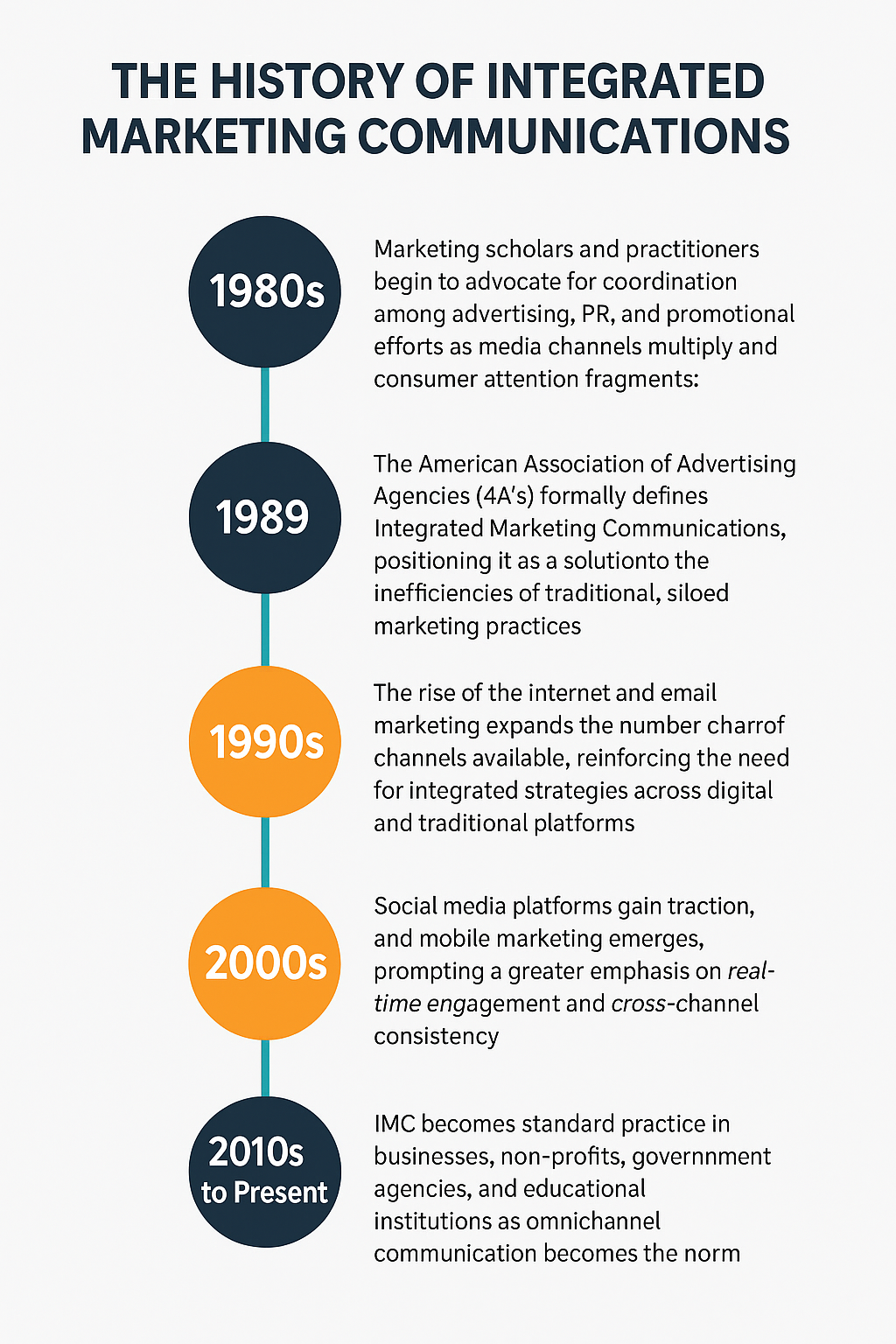
  • 1980s – Marketing scholars and practitioners begin to advocate for coordination among advertising, PR, and promotional efforts as media channels multiply and consumer attention fragments.
  • 1989 – The American Association of Advertising Agencies (4A’s) formally defines Integrated Marketing Communications, positioning it as a solution to the inefficiencies of traditional, siloed marketing practices.
  • 1990s – The rise of the internet and email marketing expands the number of channels available, reinforcing the need for integrated strategies across digital and traditional platforms.
  • 2000s – Social media platforms gain traction, and mobile marketing emerges, prompting a greater emphasis on real-time engagement and cross-channel consistency.
  • 2010s to Present – IMC becomes standard practice in businesses, non-profits, government agencies, and educational institutions as omnichannel communication becomes the norm.
Today, IMC is considered essential for building brand trust, delivering coherent narratives, and maximizing the effectiveness of communication efforts across multiple touchpoints. By integrating strategy, message, and media, IMC helps organizations connect more meaningfully with their audiences in a crowded and dynamic communication environment.


Successful IMC Campaigns

Check out a few real-world examples of integrated marketing communications in action. These widely recognized campaigns showcase how organizations across industries have used coordinated strategies to deliver clear, consistent, and powerful messages across multiple channels.

Dove: Campaign for Real Beauty

Launched in 2004, Dove’s “Campaign for Real Beauty” challenged conventional beauty standards by featuring real women of diverse ages, sizes, and ethnicities in its advertisements. The campaign utilized billboards, television commercials, digital content, and social media to promote body positivity and self-esteem. One of its most impactful components was the “Real Beauty Sketches” video, which went viral and sparked global conversations about self-perception and beauty ideals.


ALS Association: Ice Bucket Challenge

In 2014, the ALS Association’s “Ice Bucket Challenge” became a viral sensation, raising awareness and funds for amyotrophic lateral sclerosis (ALS) research. Participants filmed themselves pouring ice water over their heads and challenged others to do the same, sharing the videos across social media platforms. The campaign successfully integrated user-generated content, celebrity endorsements, and widespread media coverage, resulting in over $115 million in donations.


Red Bull: Stratos

Red Bull’s “Stratos” campaign in 2012 pushed the boundaries of marketing by sponsoring skydiver Felix Baumgartner’s record-breaking freefall from the edge of space. The event was broadcast live on YouTube, garnering millions of views and extensive media coverage. By integrating live streaming, social media engagement, and traditional advertising, Red Bull reinforced its brand image as a pioneer in extreme sports and adventure.


Always: Like a Girl

In 2014, Always launched the “#LikeAGirl” campaign to address and redefine the negative connotations associated with the phrase. Through a powerful video and social media engagement, the campaign encouraged young girls to embrace their strengths and challenged societal stereotypes. The integrated approach combined television advertising, online content, and a strong social media presence, resulting in widespread acclaim and increased brand visibility.


*Content on this page was curated and edited by expert humans with the creative assistance of AI.

  • facebook
  • instagram
  • linkedin

DON'T MISS ANY SPOT-ON TIPS!

We don't spam! You'll only get emails when we post something awesome.
You can unsubscribe at any time.

Check your inbox or spam folder to confirm your subscription.

©2025 | The Comm Spot | By Newbold Communication & Design