
Overview
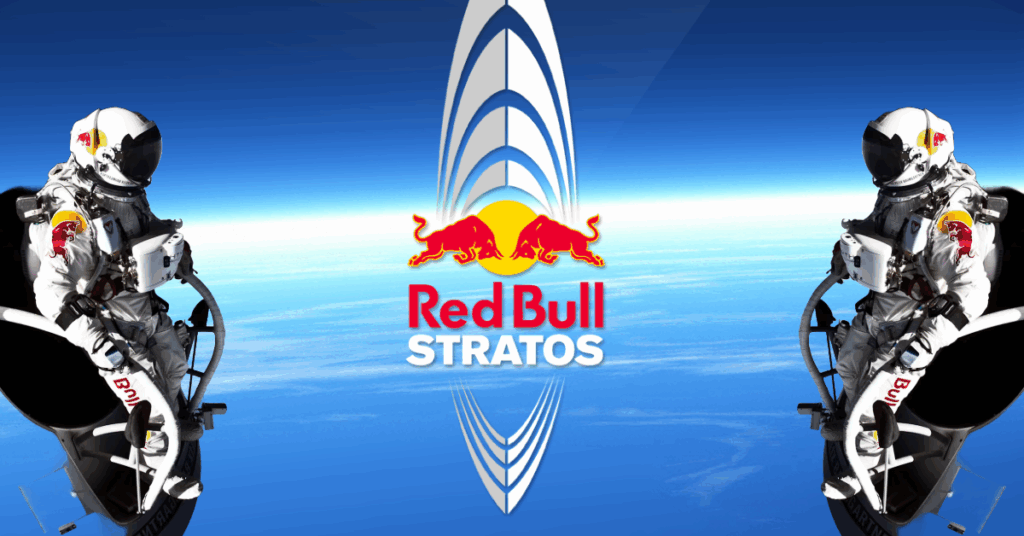
The Red Bull Stratos project in 2012 was a groundbreaking branded event in which Austrian skydiver Felix Baumgartner ascended to the edge of space in a helium balloon and performed a supersonic freefall back to Earth. Red Bull transformed what might have been a niche scientific stunt into a global media spectacle, redefining the role of brands as content creators and positioning itself not just as an energy drink company, but as a cultural producer of extreme experiences.
Context and Events
Red Bull had long invested in extreme sports sponsorships—everything from cliff diving to motocross—to reinforce its slogan, “Red Bull gives you wings.” However, Stratos represented a step beyond: instead of sponsoring an existing event, the company created one from scratch with historic ambition.
On October 14, 2012, Felix Baumgartner rode a specially designed helium balloon to an altitude of 128,000 feet (nearly 24 miles above Earth). Wearing a pressurized suit, he jumped, reaching a top speed of 843.6 mph and breaking the sound barrier during freefall. Baumgartner set records for the highest freefall and highest manned balloon flight at the time, and the event was broadcast live on YouTube and television networks worldwide.
The Stratos mission was not only a marketing stunt but also a scientific collaboration. Engineers, doctors, and aeronautical experts were deeply involved in ensuring Baumgartner’s safety, and data from the mission was shared with NASA and aerospace communities. The combination of spectacle, danger, and science captivated audiences and generated unprecedented global attention.
Communication Strategy
Red Bull orchestrated Stratos as if it were producing a feature film or a global sporting event:
- Owned-media architecture: Red Bull produced and controlled nearly all content, streaming the jump live on YouTube (setting a record for concurrent viewers at the time) and distributing cinematic highlight reels across its branded channels.
- Long-term buildup: The mission was teased for years, with behind-the-scenes videos, blog updates, and mini-documentaries building anticipation and credibility.
- Scientific framing: By positioning Stratos as both a feat of human endurance and a contribution to aerospace research, Red Bull balanced thrill-seeking with legitimacy.
- Global PR integration: Traditional media outlets received press kits, interviews, and access to imagery, ensuring worldwide coverage beyond Red Bull’s owned channels.
- Hero narrative: Felix Baumgartner was cast not only as an athlete but as a pioneer, allowing audiences to invest emotionally in his preparation, fears, and ultimate triumph.
Outcomes
The results of Red Bull Stratos were staggering:
- The live broadcast attracted over 8 million concurrent viewers on YouTube—then a record for live streaming.
- Global media coverage was estimated in the billions of impressions, with newspapers, magazines, and TV stations worldwide treating the jump as front-page news.
- Red Bull’s brand association with extreme performance deepened, and the company was widely praised for blurring the lines between content, science, and marketing.
- Though expensive (reports suggest costs upwards of $30 million), analysts estimated Red Bull received hundreds of millions of dollars in earned media value, making the investment highly cost-effective compared to traditional advertising.
- Beyond marketing, Stratos contributed meaningful aerospace data on high-altitude survival and supersonic freefall, enhancing Red Bull’s credibility in framing the stunt as a scientific achievement.
Lessons Learned
- Brands can create culture, not just sponsor it – By producing a once-in-history event, Red Bull showed that companies can be originators of experiences, not just advertisers.
- Owned media is as powerful as traditional advertising – Controlling production and distribution allowed Red Bull to act like a media company and reap long-tail benefits.
- Build anticipation over years, not days – The long runway of preparation amplified attention and positioned Stratos as a serious, newsworthy endeavor.
- Blend spectacle with substance – Framing the jump as both thrilling entertainment and scientific exploration expanded the audience and credibility.
- Invest boldly for outsized returns – Though risky and costly, Stratos demonstrated that audacious, high-stakes communication can yield far greater brand value than conventional campaigns.
*Content on this page was curated and edited by expert humans with the creative assistance of AI.