
Skip to content
The Comm Spot The Comm Spot

It's All About Communication

  • HOME
  • ABOUT
    • Meet the Creator: Curtis Newbold, PhD
    • Hire Curtis
    • Publish with Us
    • Contact
    • Privacy Notice
  • COMM-BASICS
    • Glossary
    • Citation & Style Guides
      • AP Style (Journalism)
        • AP Style Overview
        • AP Style Guidelines
        • Media Ethics – SPJ Code of Ethics
        • Elements of Newsworthiness
      • APA Style
        • APA Format – Overview
        • APA - References Guidelines
        • APA - In-text Citations
        • APA - Citing Authors
        • APA - Audiovisual Media
        • APA - Books
        • APA - Digital Sources
        • APA - Events & Interactions
        • APA - Periodicals
        • APA - Print Sources (other than books)
      • Chicago Style
        • Chicago – Overview
        • Chicago - Author-Date System
        • Chicago - Notes-Bibliography System
        • Chicago - In-text Citations
        • Chicago Style - Citing Authors
        • Chicago - Audiovisual Media
        • Chicago - Books
        • Chicago - Digital Sources
        • Chicago - Events and Interactions
        • Chicago - Citing Periodicals
        • Chicago - Print Sources (other than books)
      • MLA Style
        • MLA Overview
        • MLA Works Cited Pages
        • MLA In-text Citations
        • MLA – Authors
        • MLA – Audiovisual Media
        • MLA – Books
        • MLA – Digital Sources
        • MLA – Events & Interactions
        • MLA – Periodicals
        • MLA – Print Sources (other than books)
    • Rhetoric
      • Overview of Rhetoric
      • Rhetorical Appeals (Rhetorical Triangle)
      • Branches of Oratory
      • Canons of Rhetoric
      • Rhetorical Devices
      • Kairos
      • Topos
      • Key Figures in Rhetoric
    • Research Methods
      • Case Studies
      • Competitor Analysis
      • Content Analysis
      • Discourse Analysis
      • Ethnography
      • Focus Groups
      • Observation Research
      • S.W.O.T. Analysis
      • Secondary Research
      • Surveys
      • Target Market Analysis
      • Usability Testing
      • Visual Analysis
    • Theories
    • Thinkers
  • COMM-SUBJECTS
    • Interpersonal Communication
      • Active Listening
      • Body Language
      • Conflict Management
      • Emotional Intelligence
        • Emotional Intelligence Overview
        • Self-Awareness
        • Self-Regulation
        • Motivation
        • Empathy
        • Social Skills
        • Emotional Intelligence Resources
      • Feedback
      • Negotiation
        • Overview of Negotiation
        • Negotiation Skills
        • Negotiation Strategies & Techniques
        • Stages of Negotiation
        • Common Negotiation Scenarios
        • Negotiation Case Studies & Examples
        • Negotiation Tools & Resources
        • Negotiation FAQ
    • Journalism
    • Public Speaking
      • General Guidelines
      • Overcoming Fear
      • Speech Writing and Organization
      • Delivery Techniques
      • Body Language
      • Audience Engagement
      • Storytelling
      • Designing Slides
      • P.O.W.E.R.F.U.L. Presentation Method
    • Strategic Communication
      • Business & Org Comm
        • Definition & History
        • Org Comm Theories
        • Business Documents
        • Change Management
        • Employee Relations
        • Employment Communication
        • Group & Team Communication
        • Leadership Communication
        • Power, Identity, & Ethics at Work
        • Project Management
      • Integrated Marketing Comm
        • Definition of IMC
        • Core Principles of IMC
        • IMC Planning
        • Audience Segmentation
        • Marketing Channels
        • Message Strategies
        • Campaign Measurement & Evaluation
        • Trends & Innovations in IMC
        • Challenges & Pitfalls in IMC
        • Careers & Roles in IMC
      • Public Relations
        • Foundations in PR
        • Strategic Practice
        • Tools & Tactics
        • Research & Analysis
        • Professional Development
      • Case Studies in Strat Comm
    • Technical & Scientific Communication
    • Visual Communication
      • Data Visualization
      • Information Design
      • Photography
      • Web Design
    • Written Communication
      • Writing Process
      • Organizational Methods
        • Five Paragraph Essay
        • Hourglass Method of Writing
        • IMRaD Format (Science)
        • Indirect Method (Bad News)
        • Inverted Pyramid (Journalism)
        • Martini Glass
        • Narrative Format
        • Proposal Format
        • Rogerian Method
        • Toulmin Method
      • Plain Language
        • Audience (Plain Language)
        • Organization (Plain Language)
        • Conversation (Plain Language)
        • Simplicity (Plain Language)
        • Word Choice (Plain Language)
        • Sentence Structure (Plain Language)
        • Design (Plain Language)
      • Punctuation
        • Apostrophes
        • Brackets
        • Colons
        • Commas
        • Ellipses
        • Em Dashes
        • En Dashes
        • Exclamation Marks
        • Hyphens
        • Parentheses
        • Periods
        • Question Marks
        • Quotation Marks
        • Semicolons
      • Style
        • Clarity
        • Conciseness
        • Consistency
        • Editing
        • Flow
        • Rhetorical Devices
        • Sentence Structure
        • Storytelling
        • Tone
        • Voice
        • Word Choice
  • RESOURCES
    • Teaching Resources
      • Assignments & Activities
      • Instructional Design
      • Pedagogies
  • BLOGS
    • The Spotlight Blog
    • Comm Sparks
  • SHOP
    • Cart
    • Checkout
0
The Comm Spot
The Comm Spot

It's All About Communication

Marketing & Advertising Case Study: “Got Milk?” Campaign (1993 – 2000s)

Home >COMM-Subjects >Strategic Communication >Case Studies in Strategic Communication >Marketing & Advertising Case Study: “Got Milk?” Campaign (1993 – 2000s)

Overview

The “Got Milk?” campaign, launched in California in 1993 and later expanded nationally, is one of the most recognizable and parodied advertising campaigns of all time. With its minimalist two-word slogan and iconic milk mustache visuals, the campaign reinvigorated consumer interest in milk by reframing it as essential to everyday enjoyment rather than just a basic grocery staple. Its cultural impact extended far beyond the beverage aisle, embedding itself in American pop culture.


Context and Events

In the early 1990s, U.S. milk consumption was declining as consumers shifted toward sodas, juices, and alternative beverages. The California Milk Processor Board (CMPB) hired ad agency Goodby Silverstein & Partners to develop a campaign that would make milk feel relevant again.

The first ad, titled “Aaron Burr” (1993), featured a history buff who misses his chance to answer a $10,000 trivia question about Alexander Hamilton because his mouth is too full of peanut butter—and he has no milk to wash it down. The tagline: “Got Milk?”

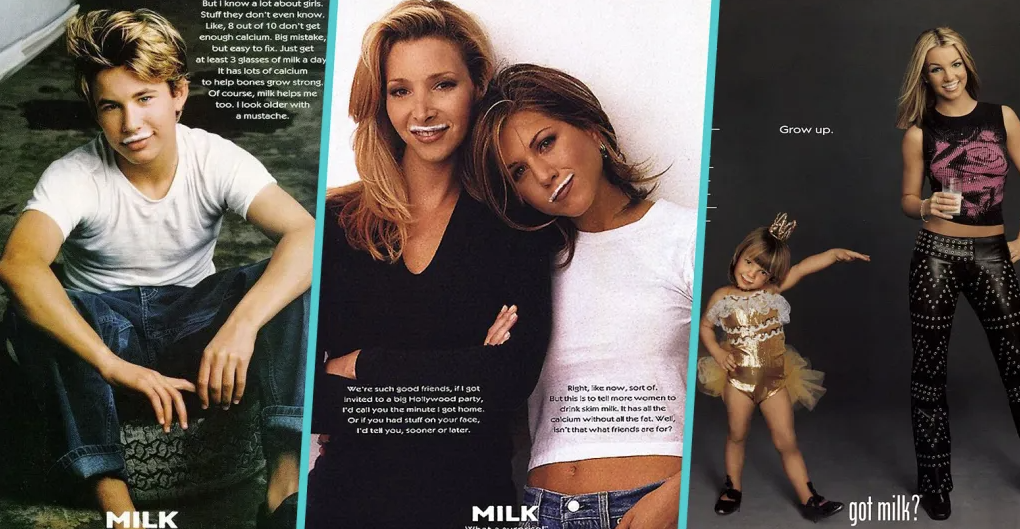
The campaign quickly expanded nationwide with the National Milk Processor Board, introducing the milk mustache ads in 1995. These featured celebrities—from athletes to actors—sporting white milk mustaches with the “Got Milk?” slogan beneath.


Communication Strategy

The campaign succeeded by combining simplicity, humor, and cultural integration:

  • Minimalist slogan: “Got Milk?” was short, provocative, and adaptable to countless situations.
  • Humor and relatability: Ads focused on scenarios where milk was missing—making milk seem indispensable.
  • Celebrity appeal: Milk mustache ads featured hundreds of celebrities (e.g., Britney Spears, David Beckham, Beyoncé), making milk aspirational.
  • Pop culture tie-ins: Ads appeared in magazines, billboards, TV spots, and classrooms, embedding the slogan into everyday life.
  • Universal adaptability: The tagline was flexible, spawning endless parodies and adaptations (“Got Game?”, “Got Books?”).

Outcomes

The campaign achieved remarkable visibility and cultural staying power:

  • Sales impact: While milk consumption did not dramatically reverse long-term declines, the campaign stabilized sales and boosted awareness, especially in California.
  • Cultural phenomenon: “Got Milk?” became one of the most quoted and imitated slogans of the 1990s and 2000s.
  • Awards: The original “Aaron Burr” ad won a Clio Award and was named one of the greatest commercials of all time by USA Today.
  • Longevity: The milk mustache ads ran for over two decades, featuring more than 300 celebrities and athletes.
  • Legacy: Even after its official retirement in 2014, the slogan remains instantly recognizable and frequently referenced in popular culture.

Lessons Learned

  1. Simplicity resonates – A two-word slogan created decades of cultural recognition.
  2. Humor drives memorability – Relatable, funny scenarios gave milk an unexpected edge.
  3. Celebrity marketing amplifies reach – The milk mustache campaign turned everyday consumption into aspirational behavior.
  4. Cultural adaptability sustains relevance – Endless parodies and spin-offs kept the slogan alive in public imagination.
  5. Advertising can build equity even without reversing trends – Though milk consumption continued to decline overall, the campaign created lasting brand equity for an entire category.

*Content on this page was curated and edited by expert humans with the creative assistance of AI.

  • facebook
  • instagram
  • linkedin

DON'T MISS ANY SPOT-ON TIPS!

We don't spam! You'll only get emails when we post something awesome.
You can unsubscribe at any time.

Check your inbox or spam folder to confirm your subscription.

©2025 | The Comm Spot | By Newbold Communication & Design