

Leading Through Change: The Role of Managers and Change Agents
In every successful organizational change, behind the scenes (and often front and center) are managers and change agents guiding their teams through the uncertainty, disruption, and opportunity that change brings. While executive sponsors may craft the vision and direction, it is the middle managers, frontline supervisors, and influential peers who translate strategy into behavior.
Managers and change agents are not just messengers of change—they are its most visible models and stewards. When they lead effectively, teams are more resilient, adaptable, and engaged. When they don’t, even the best-designed initiatives can stall.
This page walks through a step-by-step process for empowering managers and change agents to lead through change, with practical strategies and case examples to illustrate what effective leadership looks like during transformation.
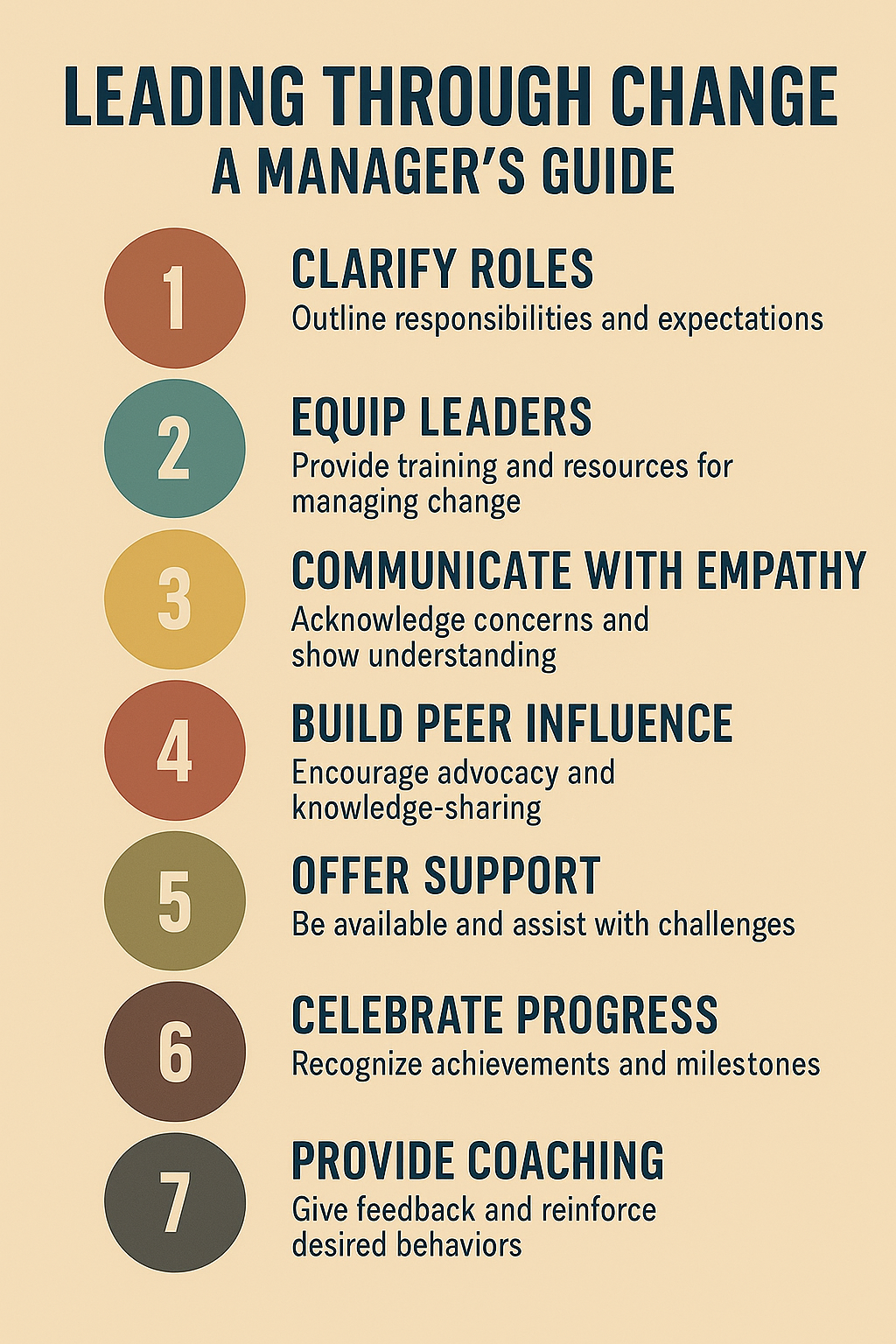
Step 1: Clarify Roles and Expectations
Change management often struggles when people don’t understand their role in the process. Managers and change agents need a clear definition of what is expected of them—not just what the change is, but what they are responsible for communicating, modeling, and reinforcing.
Best Practices
- Define manager responsibilities early (e.g., inform teams, gather feedback, identify resistance)
- Provide a simple “change leadership charter” or role guide
- Ensure alignment between HR, change teams, and senior leadership
Mini Case Example:
During a national nonprofit’s rebranding initiative, HR creates a one-page guide for managers outlining their role: explain the branding rationale, collect team questions, and reinforce new messaging in meetings. This clarity helps each manager feel confident in their contribution.
Step 2: Equip Leaders to Model the Desired Behaviors
People don’t adopt change based on policy—they adopt it based on what they see others doing. Managers and influencers must consistently demonstrate the new behaviors expected in the future state.
Best Practices
- Train managers in the “soft” side of change: empathy, self-awareness, and role modeling
- Identify visible behaviors that signal adoption (e.g., using new systems, attending new training)
- Make accountability public, not punitive—celebrate those who model change
Mini Case Example:
As a retail company introduces a new scheduling app, regional managers begin using it for their own teams before requiring it of store managers. Employees notice the change in behavior and begin to adopt the system without being mandated.
Step 3: Communicate with Empathy and Consistency
Managers are the most trusted source of information during times of change. But for that trust to hold, their communication must be clear, timely, and empathetic.
Best Practices
- Provide message toolkits to help managers communicate consistently
- Encourage two-way dialogue—ask questions and listen actively
- Emphasize transparency, even when all answers aren’t yet available
Mini Case Example:
A technology firm is restructuring departments. Department heads meet with small groups weekly, using talking points provided by the change team but allowing time for Q&A and personal reflection. By week three, employee anxiety drops, and feedback becomes more constructive.
Step 4: Build Peer Influence Through Change Agents
Not all change leaders are in formal leadership positions. Identifying and empowering informal influencers—respected peers across departments—helps build momentum and normalize change behaviors from the ground up.
Best Practices
- Select change agents based on influence, not title
- Involve them in early-stage planning and feedback loops
- Provide training, recognition, and ongoing access to decision-makers
Mini Case Example:
In a hospital adopting new electronic health records, the IT team recruits nurse champions to serve as change agents. These nurses attend training early and act as peer coaches during rollout. Their involvement increases confidence and reduces downtime on the floor.
Step 5: Offer Support Through Uncertainty
Even the most confident teams experience anxiety and disruption during change. Managers and change agents should serve as stabilizing forces—helping teams make sense of what’s happening, navigate setbacks, and maintain morale.
Best Practices
- Normalize emotions—acknowledge that uncertainty is part of the process
- Provide a safe space for venting without judgment
- Ensure resources are available: training, FAQs, coaching
Mini Case Example:
A global media company undergoes a merger. Team leaders host virtual “office hours” twice a week where staff can drop in to ask questions or express concerns. The format is informal, and no one is required to attend. Over time, these open sessions build trust and reduce confusion.
Step 6: Reinforce and Celebrate Progress
Change doesn’t happen all at once—and progress often feels invisible. Managers and change agents should be proactive in calling out early wins, acknowledging team efforts, and reinforcing what’s working.
Best Practices
- Share quick wins in team huddles, dashboards, or newsletters
- Recognize individuals and teams who take initiative
- Tie celebrations back to the bigger change vision
Mini Case Example:
After launching a new customer service platform, a cable provider begins tracking customer response times. One team cuts response time in half within two weeks. Their manager sends out a team-wide thank-you message and shares the story with the executive sponsor, who highlights it in an all-hands meeting.
Step 7: Provide Ongoing Coaching and Development
Change leadership is a skill, not an instinct. Managers and change agents need support to grow in this role—especially when facing unfamiliar or complex transitions.
Best Practices
- Offer bite-sized training modules on change leadership
- Set up peer learning groups or mentoring networks
- Provide regular feedback and recognition for their efforts
Mini Case Example:
A government agency rolling out a new policy framework provides “Change Coaching Circles” where department heads meet monthly to share challenges, learn from others, and work through real-time case studies. The sessions are facilitated by an external coach but driven by participants’ experiences.
Step 8: Measure Engagement and Adapt Tactics
Effective leadership during change can—and should—be measured. Organizations should regularly check in on how well managers and change agents are supporting the change and adjust support strategies accordingly.
Best Practices
- Use surveys or pulse checks to assess team engagement and leadership effectiveness
- Gather anecdotal feedback through one-on-ones and retrospectives
- Adjust message frequency, resources, or training based on real-time needs
Mini Case Example:
An insurance company’s HR team sends a short pulse survey two weeks after rolling out a major workflow change. Results show most teams feel well-informed, but newer managers feel less confident answering questions. In response, HR hosts a dedicated Q&A session for managers and updates the change FAQ.
*Content on this page was curated and edited by expert humans with the creative assistance of AI.