Skip to content
The Comm Spot The Comm Spot

It's All About Communication

  • HOME
  • ABOUT
    • Meet the Creator: Curtis Newbold, PhD
    • Hire Curtis
    • Publish with Us
    • Contact
    • Privacy Notice
  • COMM-BASICS
    • Glossary
    • Citation & Style Guides
      • AP Style (Journalism)
        • AP Style Overview
        • AP Style Guidelines
        • Media Ethics – SPJ Code of Ethics
        • Elements of Newsworthiness
      • APA Style
        • APA Format – Overview
        • APA - References Guidelines
        • APA - In-text Citations
        • APA - Citing Authors
        • APA - Audiovisual Media
        • APA - Books
        • APA - Digital Sources
        • APA - Events & Interactions
        • APA - Periodicals
        • APA - Print Sources (other than books)
      • Chicago Style
        • Chicago – Overview
        • Chicago - Author-Date System
        • Chicago - Notes-Bibliography System
        • Chicago - In-text Citations
        • Chicago Style - Citing Authors
        • Chicago - Audiovisual Media
        • Chicago - Books
        • Chicago - Digital Sources
        • Chicago - Events and Interactions
        • Chicago - Citing Periodicals
        • Chicago - Print Sources (other than books)
      • MLA Style
        • MLA Overview
        • MLA Works Cited Pages
        • MLA In-text Citations
        • MLA – Authors
        • MLA – Audiovisual Media
        • MLA – Books
        • MLA – Digital Sources
        • MLA – Events & Interactions
        • MLA – Periodicals
        • MLA – Print Sources (other than books)
    • Rhetoric
      • Overview of Rhetoric
      • Rhetorical Appeals (Rhetorical Triangle)
      • Branches of Oratory
      • Canons of Rhetoric
      • Rhetorical Devices
      • Kairos
      • Topos
      • Key Figures in Rhetoric
    • Research Methods
      • Case Studies
      • Competitor Analysis
      • Content Analysis
      • Discourse Analysis
      • Ethnography
      • Focus Groups
      • Observation Research
      • S.W.O.T. Analysis
      • Secondary Research
      • Surveys
      • Target Market Analysis
      • Usability Testing
      • Visual Analysis
    • Theories
    • Thinkers
  • COMM-SUBJECTS
    • Interpersonal Communication
      • Active Listening
      • Body Language
      • Conflict Management
      • Emotional Intelligence
        • Emotional Intelligence Overview
        • Self-Awareness
        • Self-Regulation
        • Motivation
        • Empathy
        • Social Skills
        • Emotional Intelligence Resources
      • Feedback
      • Negotiation
        • Overview of Negotiation
        • Negotiation Skills
        • Negotiation Strategies & Techniques
        • Stages of Negotiation
        • Common Negotiation Scenarios
        • Negotiation Case Studies & Examples
        • Negotiation Tools & Resources
        • Negotiation FAQ
    • Journalism
    • Public Speaking
      • General Guidelines
      • Overcoming Fear
      • Speech Writing and Organization
      • Delivery Techniques
      • Body Language
      • Audience Engagement
      • Storytelling
      • Designing Slides
      • P.O.W.E.R.F.U.L. Presentation Method
    • Strategic Communication
      • Business & Org Comm
        • Definition & History
        • Org Comm Theories
        • Business Documents
        • Change Management
        • Employee Relations
        • Employment Communication
        • Group & Team Communication
        • Leadership Communication
        • Power, Identity, & Ethics at Work
        • Project Management
      • Integrated Marketing Comm
        • Definition of IMC
        • Core Principles of IMC
        • IMC Planning
        • Audience Segmentation
        • Marketing Channels
        • Message Strategies
        • Campaign Measurement & Evaluation
        • Trends & Innovations in IMC
        • Challenges & Pitfalls in IMC
        • Careers & Roles in IMC
      • Public Relations
        • Foundations in PR
        • Strategic Practice
        • Tools & Tactics
        • Research & Analysis
        • Professional Development
      • Case Studies in Strat Comm
    • Technical & Scientific Communication
    • Visual Communication
      • Data Visualization
      • Information Design
      • Photography
      • Web Design
    • Written Communication
      • Writing Process
      • Organizational Methods
        • Five Paragraph Essay
        • Hourglass Method of Writing
        • IMRaD Format (Science)
        • Indirect Method (Bad News)
        • Inverted Pyramid (Journalism)
        • Martini Glass
        • Narrative Format
        • Proposal Format
        • Rogerian Method
        • Toulmin Method
      • Plain Language
        • Audience (Plain Language)
        • Organization (Plain Language)
        • Conversation (Plain Language)
        • Simplicity (Plain Language)
        • Word Choice (Plain Language)
        • Sentence Structure (Plain Language)
        • Design (Plain Language)
      • Punctuation
        • Apostrophes
        • Brackets
        • Colons
        • Commas
        • Ellipses
        • Em Dashes
        • En Dashes
        • Exclamation Marks
        • Hyphens
        • Parentheses
        • Periods
        • Question Marks
        • Quotation Marks
        • Semicolons
      • Style
        • Clarity
        • Conciseness
        • Consistency
        • Editing
        • Flow
        • Rhetorical Devices
        • Sentence Structure
        • Storytelling
        • Tone
        • Voice
        • Word Choice
  • RESOURCES
    • Teaching Resources
      • Assignments & Activities
      • Instructional Design
      • Pedagogies
  • BLOGS
    • The Spotlight Blog
    • Comm Sparks
  • SHOP
    • Cart
    • Checkout
0
The Comm Spot
The Comm Spot

It's All About Communication

Proposals (Business Communication)

Home >COMM-Subjects >Strategic Communication >Business & Organizational Communication >Business Documents >Proposals (Business Communication)

Business proposals are persuasive documents designed to win approval, funding, or cooperation for an idea, project, or service. Whether you’re pitching to clients, internal leadership, or other stakeholders, an effective proposal must communicate value, feasibility, and professionalism.

How to Write Effective Business Proposals (Best Practices)

A proposal is only as effective as it is clear, persuasive, and tailored to its audience. Strong proposals anticipate objections, answer key questions, and show the benefits of your idea or service.

Best Practices:

  • Identify your audience and write to their interests and knowledge level.
  • Define the problem clearly and explain why your solution is necessary.
  • Organize information logically using headings, subheadings, and visuals.
  • Use concise, persuasive, and objective language throughout.
  • Support all claims with credible evidence or data.
  • Close with a strong, clear call to action or recommendation.
  • Proofread for accuracy, tone, and consistency.

Avoid:

  • Writing with vague, generalized claims.
  • Using jargon your audience may not understand.
  • Making the document overly long or unfocused.

When to Use Proposals at Work

Proposals are appropriate when formal documentation is required to persuade decision-makers, outline plans, or request approval or resources.

Use proposals to:

  • Pitch a product, service, or business idea to a client or partner.
  • Request funding or resources for a department or project.
  • Suggest operational changes, innovations, or research initiatives.
  • Bid for contracts, grants, or projects.
  • Collaborate across teams or departments with complex needs.

Avoid proposals when:

  • A brief email, meeting, or report would suffice.
  • You’re only providing information without making a recommendation.
  • The situation requires informal or exploratory discussion first.

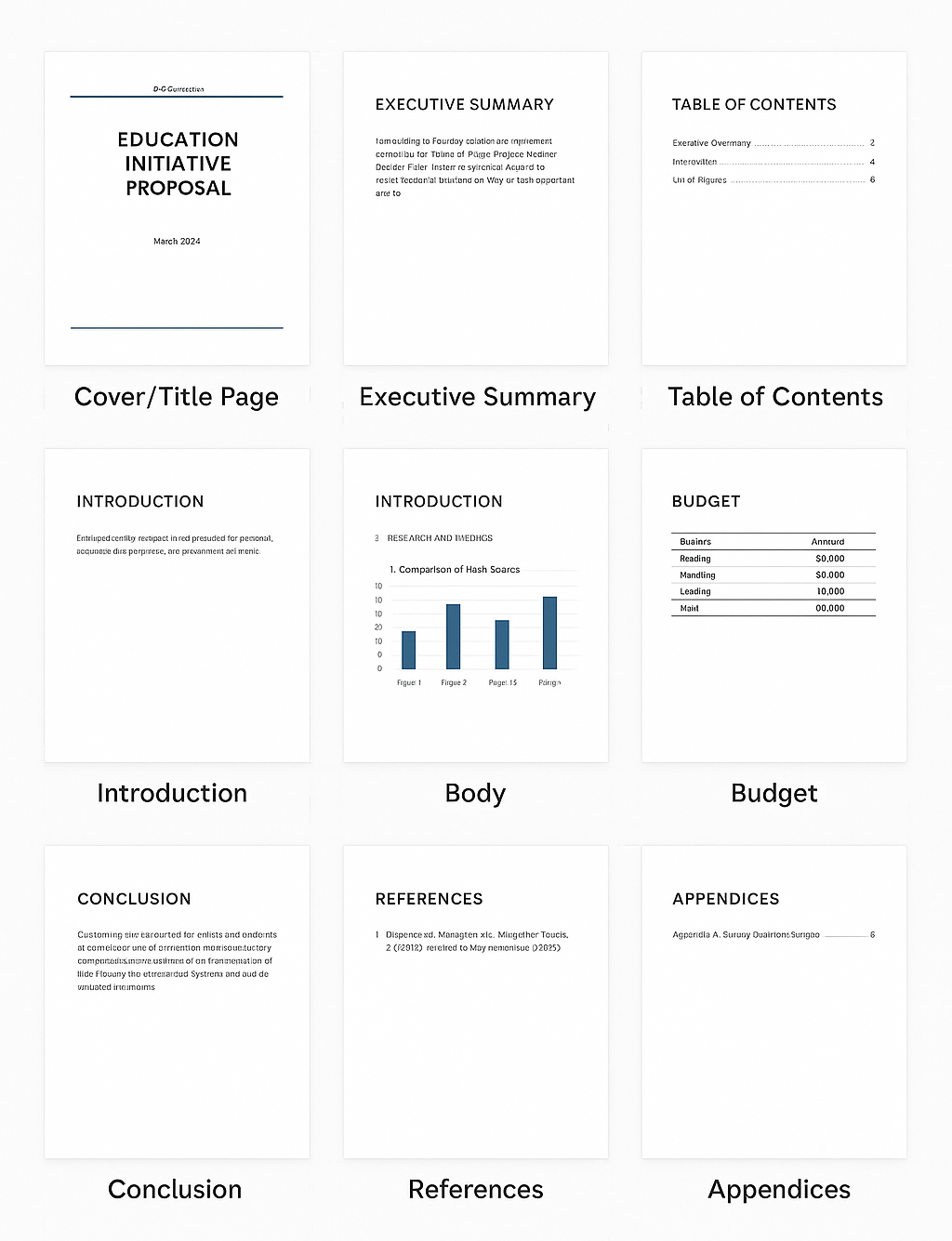
Parts of a Proposal (with Visual Example)

Not all proposals require every section, but knowing the common components helps you adapt your structure to the audience and purpose.

Common Parts of a Business Proposal:

  • Cover/Title Page
    Include the title of the proposal, your name or team name, company name, date, and any relevant identifiers (proposal number, client info, etc.).
  • Executive Summary
    Provide a concise, one-page overview of the entire proposal. Summarize the problem, proposed solution, benefits, and anticipated outcomes.
  • Table of Contents
    Help readers navigate the proposal, especially if it’s longer than four pages.
  • List of Figures/Tables
    Include if your proposal contains several visual elements. This allows quick reference to charts, graphs, and tables.
  • Introduction
    Briefly define the problem or need and state your objective or purpose for writing the proposal.
  • Body
    Present research, methodology, discussion, analysis, solution options, timelines, scope, and deliverables. Organize with headers and visuals for clarity.
  • Budget
    Outline the estimated costs associated with your proposal, including breakdowns by category (labor, equipment, services, etc.).
  • Conclusion
    Reinforce your recommendation and benefits. Clearly restate the next steps or what action you want the reader to take.
  • References
    Cite all external sources of data, research, or quoted material using an appropriate format (APA, MLA, etc.).
  • Appendices
    Include supplementary materials like resumes, charts, maps, or detailed data that support your main content.
  • Optional Elements:
    • Qualifications: Briefly describe your team’s or firm’s capabilities.
    • Timeline: Provide a schedule for deliverables and milestones.
    • Terms & Conditions: Detail any legal or logistical constraints.
Writing Effective Proposals

Strong writing turns a good idea into a winning proposal. Your tone should be confident, your reasoning should be logical, and your format should invite easy reading.

Best Practices:

  • Start with a compelling executive summary—most decision-makers read it first.
  • Use short, focused paragraphs with clear topic sentences.
  • Write persuasively, showing how your proposal solves a real problem.
  • Tailor your message to the specific audience—avoid generic templates.
  • Use active voice and avoid hedging language (e.g., “we believe” vs. “we will”).
  • Edit ruthlessly—cut anything that doesn’t add value.

Avoid:

  • Overwhelming your reader with too much technical detail.
  • Writing a dense block of text without sectioning.
  • Being too casual or overpromising.

Using Figures and Tables in Proposals

Visual elements help clarify complex ideas and enhance credibility—especially in proposals that involve data or comparisons.

Best Practices:

  • Use charts, tables, timelines, or infographics to display data clearly.
  • Label all visuals with descriptive titles and figure numbers.
  • Refer to figures directly in the text (e.g., “See Figure 2 for budget breakdown”).
  • Use consistent formatting and color schemes across visuals.
  • Place visuals near the relevant text, not all in the appendix.

Avoid:

  • Inserting visuals without explanation in the body text.
  • Overusing decorative graphics that distract from your argument.
  • Using low-resolution or hard-to-read visuals.

*Content on this page was curated and edited by expert humans with the creative assistance of AI.

  • facebook
  • instagram
  • linkedin

DON'T MISS ANY SPOT-ON TIPS!

We don't spam! You'll only get emails when we post something awesome.
You can unsubscribe at any time.

Check your inbox or spam folder to confirm your subscription.

©2025 | The Comm Spot | By Newbold Communication & Design