

Skip to content
The Comm Spot The Comm Spot

It's All About Communication

  • HOME
  • ABOUT
    • Meet the Creator: Curtis Newbold, PhD
    • Hire Curtis
    • Publish with Us
    • Contact
    • Privacy Notice
  • COMM-BASICS
    • Glossary
    • Citation & Style Guides
      • AP Style (Journalism)
        • AP Style Overview
        • AP Style Guidelines
        • Media Ethics – SPJ Code of Ethics
        • Elements of Newsworthiness
      • APA Style
        • APA Format – Overview
        • APA - References Guidelines
        • APA - In-text Citations
        • APA - Citing Authors
        • APA - Audiovisual Media
        • APA - Books
        • APA - Digital Sources
        • APA - Events & Interactions
        • APA - Periodicals
        • APA - Print Sources (other than books)
      • Chicago Style
        • Chicago – Overview
        • Chicago - Author-Date System
        • Chicago - Notes-Bibliography System
        • Chicago - In-text Citations
        • Chicago Style - Citing Authors
        • Chicago - Audiovisual Media
        • Chicago - Books
        • Chicago - Digital Sources
        • Chicago - Events and Interactions
        • Chicago - Citing Periodicals
        • Chicago - Print Sources (other than books)
      • MLA Style
        • MLA Overview
        • MLA Works Cited Pages
        • MLA In-text Citations
        • MLA – Authors
        • MLA – Audiovisual Media
        • MLA – Books
        • MLA – Digital Sources
        • MLA – Events & Interactions
        • MLA – Periodicals
        • MLA – Print Sources (other than books)
    • Rhetoric
      • Overview of Rhetoric
      • Rhetorical Appeals (Rhetorical Triangle)
      • Branches of Oratory
      • Canons of Rhetoric
      • Rhetorical Devices
      • Kairos
      • Topos
      • Key Figures in Rhetoric
    • Research Methods
      • Case Studies
      • Competitor Analysis
      • Content Analysis
      • Discourse Analysis
      • Ethnography
      • Focus Groups
      • Observation Research
      • S.W.O.T. Analysis
      • Secondary Research
      • Surveys
      • Target Market Analysis
      • Usability Testing
      • Visual Analysis
    • Theories
    • Thinkers
  • COMM-SUBJECTS
    • Interpersonal Communication
      • Active Listening
      • Body Language
      • Conflict Management
      • Emotional Intelligence
        • Emotional Intelligence Overview
        • Self-Awareness
        • Self-Regulation
        • Motivation
        • Empathy
        • Social Skills
        • Emotional Intelligence Resources
      • Feedback
      • Negotiation
        • Overview of Negotiation
        • Negotiation Skills
        • Negotiation Strategies & Techniques
        • Stages of Negotiation
        • Common Negotiation Scenarios
        • Negotiation Case Studies & Examples
        • Negotiation Tools & Resources
        • Negotiation FAQ
    • Journalism
    • Public Speaking
      • General Guidelines
      • Overcoming Fear
      • Speech Writing and Organization
      • Delivery Techniques
      • Body Language
      • Audience Engagement
      • Storytelling
      • Designing Slides
      • P.O.W.E.R.F.U.L. Presentation Method
    • Strategic Communication
      • Business & Org Comm
        • Definition & History
        • Org Comm Theories
        • Business Documents
        • Change Management
        • Employee Relations
        • Employment Communication
        • Group & Team Communication
        • Leadership Communication
        • Power, Identity, & Ethics at Work
        • Project Management
      • Integrated Marketing Comm
        • Definition of IMC
        • Core Principles of IMC
        • IMC Planning
        • Audience Segmentation
        • Marketing Channels
        • Message Strategies
        • Campaign Measurement & Evaluation
        • Trends & Innovations in IMC
        • Challenges & Pitfalls in IMC
        • Careers & Roles in IMC
      • Public Relations
        • Foundations in PR
        • Strategic Practice
        • Tools & Tactics
        • Research & Analysis
        • Professional Development
      • Case Studies in Strat Comm
    • Technical & Scientific Communication
    • Visual Communication
      • Data Visualization
      • Information Design
      • Photography
      • Web Design
    • Written Communication
      • Writing Process
      • Organizational Methods
        • Five Paragraph Essay
        • Hourglass Method of Writing
        • IMRaD Format (Science)
        • Indirect Method (Bad News)
        • Inverted Pyramid (Journalism)
        • Martini Glass
        • Narrative Format
        • Proposal Format
        • Rogerian Method
        • Toulmin Method
      • Plain Language
        • Audience (Plain Language)
        • Organization (Plain Language)
        • Conversation (Plain Language)
        • Simplicity (Plain Language)
        • Word Choice (Plain Language)
        • Sentence Structure (Plain Language)
        • Design (Plain Language)
      • Punctuation
        • Apostrophes
        • Brackets
        • Colons
        • Commas
        • Ellipses
        • Em Dashes
        • En Dashes
        • Exclamation Marks
        • Hyphens
        • Parentheses
        • Periods
        • Question Marks
        • Quotation Marks
        • Semicolons
      • Style
        • Clarity
        • Conciseness
        • Consistency
        • Editing
        • Flow
        • Rhetorical Devices
        • Sentence Structure
        • Storytelling
        • Tone
        • Voice
        • Word Choice
  • RESOURCES
    • Teaching Resources
      • Assignments & Activities
      • Instructional Design
      • Pedagogies
  • BLOGS
    • The Spotlight Blog
    • Comm Sparks
  • SHOP
    • Cart
    • Checkout
0
The Comm Spot
The Comm Spot

It's All About Communication

Storytelling in Public Speaking

Home >COMM-Subjects >Public Speaking >Storytelling in Public Speaking

Storytelling is one of the most powerful tools in communication, transforming ordinary presentations into memorable and impactful experiences. Whether you’re persuading clients, inspiring teams, or educating audiences, weaving stories into your presentation can engage listeners and make your message resonate.

Key Components of Stories

To effectively integrate storytelling into presentations, be sure to always include the five basic components of a compelling narrative:

  1. Characters — These are the people or entities that drive the story. Relatable and well-developed characters help the audience emotionally invest in the narrative.
  2. Setting — The environment where the story takes place provides context and background, grounding the story in reality or imagination.
  3. Plot — This is the sequence of events that move the story forward, typically structured with a beginning, middle, and end.
  4. Conflict — The challenge or problem that the characters face. Conflict creates tension and keeps the audience engaged.
  5. Resolution — The conclusion where the conflict is resolved, providing closure and reinforcing the story’s message.

Four Effective Ways to Integrate Stories

Option 1: Start and Summary
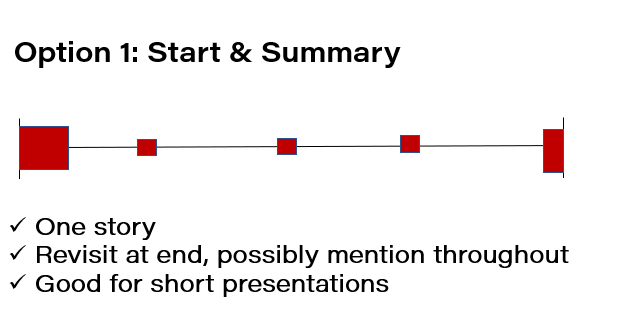
How It Works: Begin your presentation with a story that illustrates the central theme or problem. Reference it throughout the presentation, adding details or callbacks, and conclude by revisiting the story to tie everything together.

Why Use It: This method creates a strong opening hook and delivers a satisfying conclusion, making the message more cohesive and memorable.

Example: A marketing consultant starts by telling the story of a small bakery struggling to attract customers. Throughout the presentation, the consultant introduces marketing strategies, referencing how each could have helped the bakery. The presentation ends by showing how the bakery thrived after implementing these strategies.


Option 2: Small Multiples
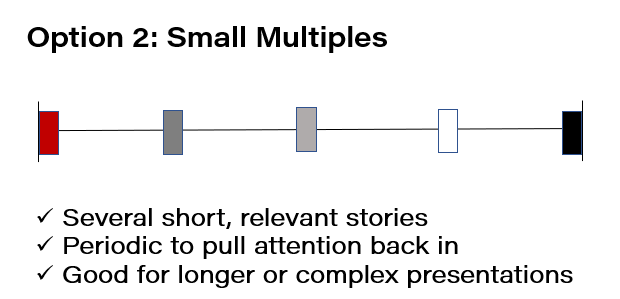
How It Works: Integrate several short, relevant stories throughout the presentation to illustrate different points or ideas.

Why Use It: This keeps the audience engaged by providing variety and concrete examples for abstract concepts.

Example: A leadership coach discussing management styles shares brief stories about four different leaders, each highlighting a unique approach to leading teams effectively.


Option 3: Stack and Combine
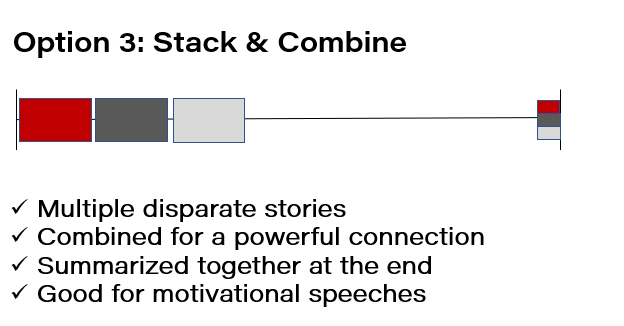
How It Works: Present multiple seemingly unrelated stories back-to-back. At the end, reveal a powerful connection that ties all the stories together.

Why Use It: This approach builds curiosity and delivers a surprising, impactful conclusion that reinforces the core message.

Example: A speaker shares stories about an athlete overcoming injury, a startup surviving a market crash, and a teacher innovating during remote learning. The presentation concludes by linking all stories to the theme of resilience in the face of adversity.


Option 4: Cliffhanger
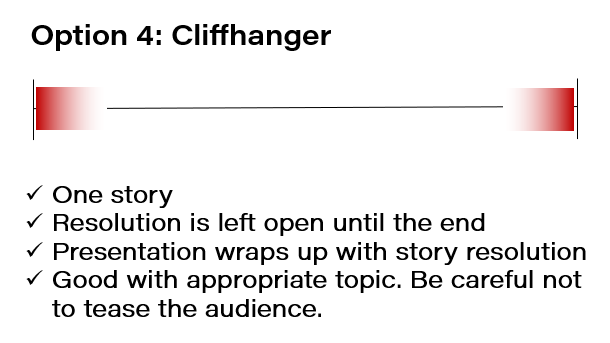
How It Works: Open with a compelling story but stop before the resolution. Throughout the presentation, build anticipation and only reveal the ending in the conclusion.

Why Use It: This technique keeps the audience engaged, encouraging them to stay attentive to learn how the story ends.

Example: A cybersecurity expert begins by describing how a company noticed unusual network activity but stops short of revealing the outcome. After explaining cybersecurity strategies, the expert concludes by detailing how the company thwarted a major cyberattack using those very strategies.


Integrating storytelling into presentations isn’t just about entertainment—it’s about connection, engagement, and impact. As you integrate the elements of effective storytelling and strategically applying different storytelling techniques, presenters can make their messages more persuasive, memorable, and meaningful.


*Content on this page was curated and edited by expert humans with the creative assistance of AI.

  • facebook
  • instagram
  • linkedin

DON'T MISS ANY SPOT-ON TIPS!

We don't spam! You'll only get emails when we post something awesome.
You can unsubscribe at any time.

Check your inbox or spam folder to confirm your subscription.

©2025 | The Comm Spot | By Newbold Communication & Design