
Skip to content
The Comm Spot The Comm Spot

It's All About Communication

  • HOME
  • ABOUT
    • Meet the Creator: Curtis Newbold, PhD
    • Hire Curtis
    • Publish with Us
    • Contact
    • Privacy Notice
  • COMM-BASICS
    • Glossary
    • Citation & Style Guides
      • AP Style (Journalism)
        • AP Style Overview
        • AP Style Guidelines
        • Media Ethics – SPJ Code of Ethics
        • Elements of Newsworthiness
      • APA Style
        • APA Format – Overview
        • APA - References Guidelines
        • APA - In-text Citations
        • APA - Citing Authors
        • APA - Audiovisual Media
        • APA - Books
        • APA - Digital Sources
        • APA - Events & Interactions
        • APA - Periodicals
        • APA - Print Sources (other than books)
      • Chicago Style
        • Chicago – Overview
        • Chicago - Author-Date System
        • Chicago - Notes-Bibliography System
        • Chicago - In-text Citations
        • Chicago Style - Citing Authors
        • Chicago - Audiovisual Media
        • Chicago - Books
        • Chicago - Digital Sources
        • Chicago - Events and Interactions
        • Chicago - Citing Periodicals
        • Chicago - Print Sources (other than books)
      • MLA Style
        • MLA Overview
        • MLA Works Cited Pages
        • MLA In-text Citations
        • MLA – Authors
        • MLA – Audiovisual Media
        • MLA – Books
        • MLA – Digital Sources
        • MLA – Events & Interactions
        • MLA – Periodicals
        • MLA – Print Sources (other than books)
    • Rhetoric
      • Overview of Rhetoric
      • Rhetorical Appeals (Rhetorical Triangle)
      • Branches of Oratory
      • Canons of Rhetoric
      • Rhetorical Devices
      • Kairos
      • Topos
      • Key Figures in Rhetoric
    • Research Methods
      • Case Studies
      • Competitor Analysis
      • Content Analysis
      • Discourse Analysis
      • Ethnography
      • Focus Groups
      • Observation Research
      • S.W.O.T. Analysis
      • Secondary Research
      • Surveys
      • Target Market Analysis
      • Usability Testing
      • Visual Analysis
    • Theories
    • Thinkers
  • COMM-SUBJECTS
    • Interpersonal Communication
      • Active Listening
      • Body Language
      • Conflict Management
      • Emotional Intelligence
        • Emotional Intelligence Overview
        • Self-Awareness
        • Self-Regulation
        • Motivation
        • Empathy
        • Social Skills
        • Emotional Intelligence Resources
      • Feedback
      • Negotiation
        • Overview of Negotiation
        • Negotiation Skills
        • Negotiation Strategies & Techniques
        • Stages of Negotiation
        • Common Negotiation Scenarios
        • Negotiation Case Studies & Examples
        • Negotiation Tools & Resources
        • Negotiation FAQ
    • Journalism
    • Public Speaking
      • General Guidelines
      • Overcoming Fear
      • Speech Writing and Organization
      • Delivery Techniques
      • Body Language
      • Audience Engagement
      • Storytelling
      • Designing Slides
      • P.O.W.E.R.F.U.L. Presentation Method
    • Strategic Communication
      • Business & Org Comm
        • Definition & History
        • Org Comm Theories
        • Business Documents
        • Change Management
        • Employee Relations
        • Employment Communication
        • Group & Team Communication
        • Leadership Communication
        • Power, Identity, & Ethics at Work
        • Project Management
      • Integrated Marketing Comm
        • Definition of IMC
        • Core Principles of IMC
        • IMC Planning
        • Audience Segmentation
        • Marketing Channels
        • Message Strategies
        • Campaign Measurement & Evaluation
        • Trends & Innovations in IMC
        • Challenges & Pitfalls in IMC
        • Careers & Roles in IMC
      • Public Relations
        • Foundations in PR
        • Strategic Practice
        • Tools & Tactics
        • Research & Analysis
        • Professional Development
      • Case Studies in Strat Comm
    • Technical & Scientific Communication
    • Visual Communication
      • Data Visualization
      • Information Design
      • Photography
      • Web Design
    • Written Communication
      • Writing Process
      • Organizational Methods
        • Five Paragraph Essay
        • Hourglass Method of Writing
        • IMRaD Format (Science)
        • Indirect Method (Bad News)
        • Inverted Pyramid (Journalism)
        • Martini Glass
        • Narrative Format
        • Proposal Format
        • Rogerian Method
        • Toulmin Method
      • Plain Language
        • Audience (Plain Language)
        • Organization (Plain Language)
        • Conversation (Plain Language)
        • Simplicity (Plain Language)
        • Word Choice (Plain Language)
        • Sentence Structure (Plain Language)
        • Design (Plain Language)
      • Punctuation
        • Apostrophes
        • Brackets
        • Colons
        • Commas
        • Ellipses
        • Em Dashes
        • En Dashes
        • Exclamation Marks
        • Hyphens
        • Parentheses
        • Periods
        • Question Marks
        • Quotation Marks
        • Semicolons
      • Style
        • Clarity
        • Conciseness
        • Consistency
        • Editing
        • Flow
        • Rhetorical Devices
        • Sentence Structure
        • Storytelling
        • Tone
        • Voice
        • Word Choice
  • RESOURCES
    • Teaching Resources
      • Assignments & Activities
      • Instructional Design
      • Pedagogies
  • BLOGS
    • The Spotlight Blog
    • Comm Sparks
  • SHOP
    • Cart
    • Checkout
0
The Comm Spot
The Comm Spot

It's All About Communication


Ignite Better Communication in 60 Seconds a Day
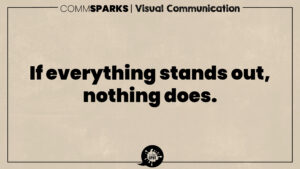

If everything stands out, nothing does.

Emphasis depends on contrast. When every element is bold, colorful, urgent, or highlighted, hierarchy disappears and attention fragments. Audiences rely ...
January 7, 2026 / Comm Sparks

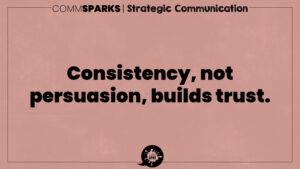
Consistency, not persuasion, builds trust.

Trust is built less by brilliant messaging than by reliable alignment over time. Persuasion can capture attention in the short ...
January 6, 2026 / Comm Sparks

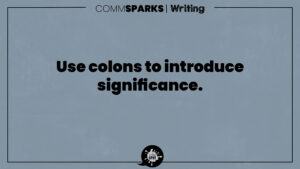
Use colons to introduce significance.

A colon is a rhetorical signal: it announces that what follows is a payoff. Unlike a comma, which suggests continuation, ...
January 6, 2026 / Comm Sparks

“To effectively communicate, we must realize we are all different.” — Tony Robbins

This principle recognizes that communication is filtered through differences in experience, values, knowledge, culture, and cognitive style. A message does ...

January 6, 2026 / Comm Sparks

Ask before you advise.

Advice often fails because it is delivered before the problem is understood. Without context, advice becomes generic, misapplied, or even ...
January 6, 2026 / Comm Sparks

End with a takeaway, not a fade-away.

Endings determine what survives. Even strong content can lose impact if it ends without consolidation, direction, or closure. A fade-away ...
January 6, 2026 / Comm Sparks

Color should communicate, not just decorate.

Color is a meaning system, not a finishing touch. It signals hierarchy (what matters first), category (what belongs together), status ...
January 6, 2026 / Comm Sparks

Say less, aim more.

Concise communication isn’t about being brief; it’s about being targeted. Length becomes a problem when it reflects uncertainty about purpose—when ...
January 6, 2026 / Comm Sparks

End sentences with what matters most.

Sentence endings carry natural emphasis. Readers tend to remember what arrives last because it functions as a rhetorical landing point—the ...
January 6, 2026 / Comm Sparks

“Design is not just what it looks like and feels like. Design is how it works.” — Steve Jobs

This principle shifts attention from aesthetics to function. Design is not primarily decoration; it is a system that shapes understanding ...
January 6, 2026 / Comm Sparks

Assumptions are silent misunderstandings.

Most workplace problems don’t start with conflict.They start with assumptions. Assumptions are quiet, easy, and usually well-intentioned. They help us ...
January 6, 2026 / Comm Sparks

Stories stick; data supports.

Stories and data do different jobs, and communication improves when each is used for what it does best. Stories create ...
January 6, 2026 / Comm Sparks

White space is an active element.

White space structures information and reduces cognitive load. It separates ideas, signals hierarchy, and improves readability. Rather than being empty, ...
January 6, 2026 / Comm Sparks

When stakes are high, clarity beats cleverness.

High-stakes communication demands precision. In contexts involving safety, policy, crisis, ethics, or accountability, ambiguity introduces risk. Clever language—metaphor, humor, or ...
January 6, 2026 / Comm Sparks

Vary sentence length for empahsis.

Sentence length shapes rhythm, pacing, and emphasis. Uniform sentence length produces monotony, while intentional variation guides attention and reinforces meaning ...
January 6, 2026 / Comm Sparks

“The single biggest problem in communication is the illusion that it has taken place.” — George Bernard Shaw

This quote exposes a common misunderstanding: communication feels complete once a message is sent. However, delivery does not guarantee understanding, ...
January 6, 2026 / Comm Sparks

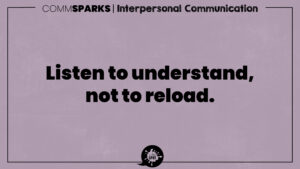
Listen to understand, not to reload.

Listening is often mistaken for waiting silently while preparing a response. In reality, this approach prioritizes defense or persuasion over ...
January 6, 2026 / Comm Sparks

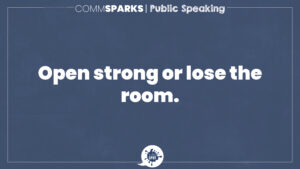
Open strong or lose the room.

Openings determine whether attention is granted or withdrawn. Audiences quickly decide whether a message is worth engaging, often within moments ...
January 6, 2026 / Comm Sparks

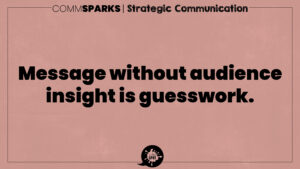
Message without audience insight is guesswork

Communication only works when it is shaped by a clear understanding of the people receiving it. Without audience insight, messages ...
January 6, 2026 / Comm Sparks

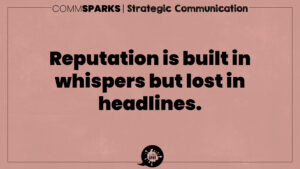
Reputation Is Built in Whispers but Lost in Headlines

Reputation is one of the most fragile and valuable assets any person or organization possesses. It’s built slowly — through ...
October 7, 2025 / Comm Sparks
  • 1
  • 2
  • ›
Loading...

©2025 | The Comm Spot | By Newbold Communication & Design