Skip to content
The Comm Spot The Comm Spot

It's All About Communication

  • HOME
  • ABOUT
    • Meet the Creator: Curtis Newbold, PhD
    • Hire Curtis
    • Publish with Us
    • Contact
    • Privacy Notice
  • COMM-BASICS
    • Glossary
    • Citation & Style Guides
      • AP Style (Journalism)
        • AP Style Overview
        • AP Style Guidelines
        • Media Ethics – SPJ Code of Ethics
        • Elements of Newsworthiness
      • APA Style
        • APA Format – Overview
        • APA - References Guidelines
        • APA - In-text Citations
        • APA - Citing Authors
        • APA - Audiovisual Media
        • APA - Books
        • APA - Digital Sources
        • APA - Events & Interactions
        • APA - Periodicals
        • APA - Print Sources (other than books)
      • Chicago Style
        • Chicago – Overview
        • Chicago - Author-Date System
        • Chicago - Notes-Bibliography System
        • Chicago - In-text Citations
        • Chicago Style - Citing Authors
        • Chicago - Audiovisual Media
        • Chicago - Books
        • Chicago - Digital Sources
        • Chicago - Events and Interactions
        • Chicago - Citing Periodicals
        • Chicago - Print Sources (other than books)
      • MLA Style
        • MLA Overview
        • MLA Works Cited Pages
        • MLA In-text Citations
        • MLA – Authors
        • MLA – Audiovisual Media
        • MLA – Books
        • MLA – Digital Sources
        • MLA – Events & Interactions
        • MLA – Periodicals
        • MLA – Print Sources (other than books)
    • Rhetoric
      • Overview of Rhetoric
      • Rhetorical Appeals (Rhetorical Triangle)
      • Branches of Oratory
      • Canons of Rhetoric
      • Rhetorical Devices
      • Kairos
      • Topos
      • Key Figures in Rhetoric
    • Research Methods
      • Case Studies
      • Competitor Analysis
      • Content Analysis
      • Discourse Analysis
      • Ethnography
      • Focus Groups
      • Observation Research
      • S.W.O.T. Analysis
      • Secondary Research
      • Surveys
      • Target Market Analysis
      • Usability Testing
      • Visual Analysis
    • Theories
    • Thinkers
  • COMM-SUBJECTS
    • Interpersonal Communication
      • Active Listening
      • Body Language
      • Conflict Management
      • Emotional Intelligence
        • Emotional Intelligence Overview
        • Self-Awareness
        • Self-Regulation
        • Motivation
        • Empathy
        • Social Skills
        • Emotional Intelligence Resources
      • Feedback
      • Negotiation
        • Overview of Negotiation
        • Negotiation Skills
        • Negotiation Strategies & Techniques
        • Stages of Negotiation
        • Common Negotiation Scenarios
        • Negotiation Case Studies & Examples
        • Negotiation Tools & Resources
        • Negotiation FAQ
    • Journalism
    • Public Speaking
      • General Guidelines
      • Overcoming Fear
      • Speech Writing and Organization
      • Delivery Techniques
      • Body Language
      • Audience Engagement
      • Storytelling
      • Designing Slides
      • P.O.W.E.R.F.U.L. Presentation Method
    • Strategic Communication
      • Business & Org Comm
        • Definition & History
        • Org Comm Theories
        • Business Documents
        • Change Management
        • Employee Relations
        • Employment Communication
        • Group & Team Communication
        • Leadership Communication
        • Power, Identity, & Ethics at Work
        • Project Management
      • Integrated Marketing Comm
        • Definition of IMC
        • Core Principles of IMC
        • IMC Planning
        • Audience Segmentation
        • Marketing Channels
        • Message Strategies
        • Campaign Measurement & Evaluation
        • Trends & Innovations in IMC
        • Challenges & Pitfalls in IMC
        • Careers & Roles in IMC
      • Public Relations
        • Foundations in PR
        • Strategic Practice
        • Tools & Tactics
        • Research & Analysis
        • Professional Development
      • Case Studies in Strat Comm
    • Technical & Scientific Communication
    • Visual Communication
      • Data Visualization
      • Information Design
      • Photography
      • Web Design
    • Written Communication
      • Writing Process
      • Organizational Methods
        • Five Paragraph Essay
        • Hourglass Method of Writing
        • IMRaD Format (Science)
        • Indirect Method (Bad News)
        • Inverted Pyramid (Journalism)
        • Martini Glass
        • Narrative Format
        • Proposal Format
        • Rogerian Method
        • Toulmin Method
      • Plain Language
        • Audience (Plain Language)
        • Organization (Plain Language)
        • Conversation (Plain Language)
        • Simplicity (Plain Language)
        • Word Choice (Plain Language)
        • Sentence Structure (Plain Language)
        • Design (Plain Language)
      • Punctuation
        • Apostrophes
        • Brackets
        • Colons
        • Commas
        • Ellipses
        • Em Dashes
        • En Dashes
        • Exclamation Marks
        • Hyphens
        • Parentheses
        • Periods
        • Question Marks
        • Quotation Marks
        • Semicolons
      • Style
        • Clarity
        • Conciseness
        • Consistency
        • Editing
        • Flow
        • Rhetorical Devices
        • Sentence Structure
        • Storytelling
        • Tone
        • Voice
        • Word Choice
  • RESOURCES
    • Teaching Resources
      • Assignments & Activities
      • Instructional Design
      • Pedagogies
  • BLOGS
    • The Spotlight Blog
    • Comm Sparks
  • SHOP
    • Cart
    • Checkout
0
The Comm Spot
The Comm Spot

It's All About Communication

Funnel Chart

Home >COMM-Subjects >Visual Communication >Data Visualization >Types of Data Visualizations (Charts and Graphs) >Funnel Chart

Funnel Chart: How to Show Drop-Off, Conversion, and Progression

A funnel chart is what you use when the story is about attrition—how many start, how many continue, and how many make it to the end.


What a Funnel Chart Is

A funnel chart visualizes a process made up of sequential stages, where the number of items typically decreases at each step. Each stage is represented by a segment that narrows as values decline, creating the familiar funnel shape.

The width of each section represents quantity, and the visual tapering reinforces loss, filtering, or conversion as the process unfolds.

Funnel charts are not about comparison across categories. They are about movement through a system.


When to Use a Funnel Chart

Use a funnel chart when progression through stages is the core message.

This chart works especially well when the goal is to:

  • Show conversion rates
  • Highlight drop-off points
  • Visualize pipelines or workflows
  • Communicate filtering or screening processes
  • Emphasize efficiency or leakage
  • Tell a step-by-step story

A funnel chart is most effective when the key question is:
“How many make it from one stage to the next?”


Types of Data Sets That Work Best for a Funnel Chart

Funnel charts work best with ordered, stage-based count data.

Strong candidates include:

  • Sales or marketing pipelines
  • Website conversion paths
  • Application or admissions processes
  • Hiring and recruitment stages
  • Customer onboarding flows
  • Manufacturing or quality screening steps

Each stage must follow logically from the previous one. If stages are independent, a funnel chart will mislead.


Real-World Examples of a Funnel Chart

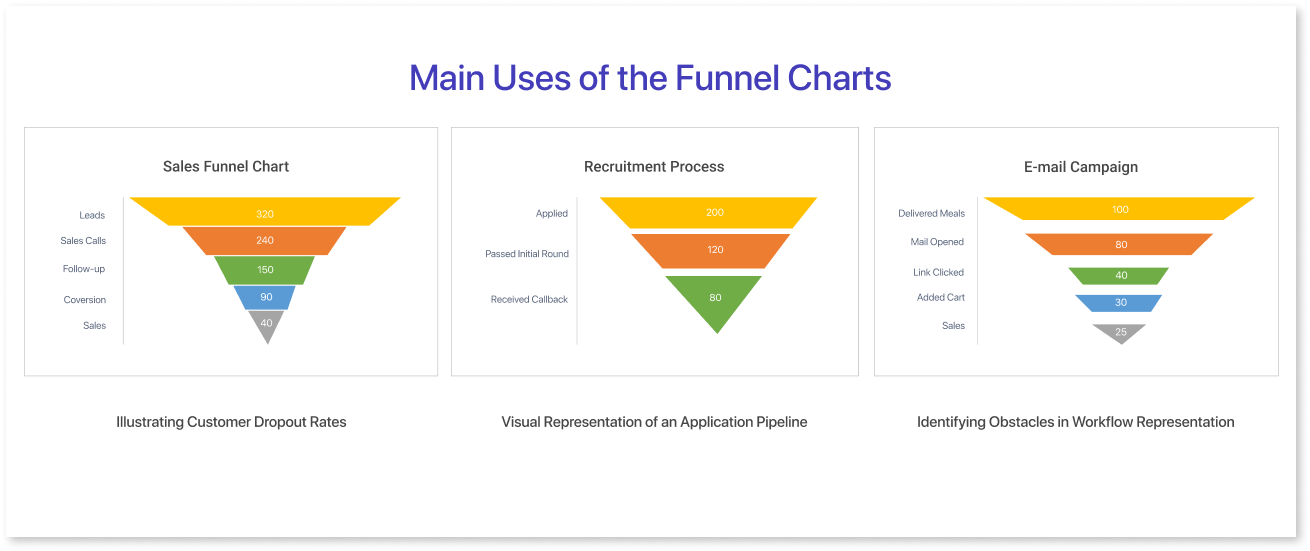
Funnel charts are common in marketing, operations, product design, and analytics.


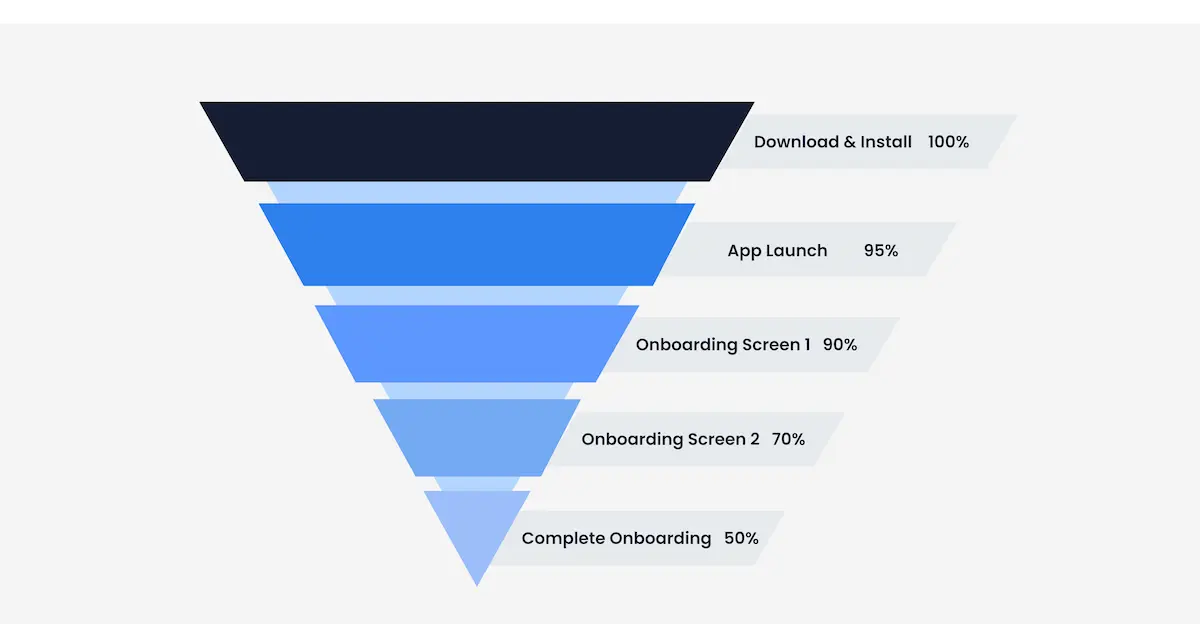
Website or App Conversion
https://mokkupai.s3.ap-south-1.amazonaws.com/files/assets/blogs/resources/8ca6248b-afbc-43e3-a42e-a3ff8f6a1d66.png
https://images.ctfassets.net/vv1yxl437u7d/766NmYoKaCMlgmm66IKPHG/3016bab6f96e11ee66273e5f8a19199a/App_Onboarding_Funnels.webp

Track how users move from landing page to sign-up, purchase, or completion.


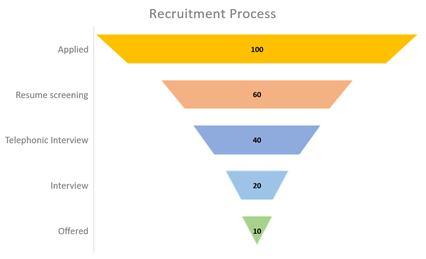
Hiring or Recruitment Process

https://images.openai.com/static-rsc-3/9zY2jKjK8F7ReiHmZ0iZ3MSHmoUPQ-B5oGdDEIBmHpEz3YmMKM7s-Q_iij9UJ7hvI93hiQbmgKd0HgsCfiLtqYOwrwqe3QSfbAZCCFMsxzY?purpose=fullsize&v=1
https://images.openai.com/static-rsc-3/vrhBuU6PDOqsgqPtqhNGrwEY-OHbCNkHMHiRu1E_aGTkX0ZayMHRC_JOi5Rf46ngob90Sfr2-B50AE_Dtnay9zqZF4mebsQnuUk4t1ROy28?purpose=fullsize&v=1

Visualize how candidates are screened, interviewed, and selected.


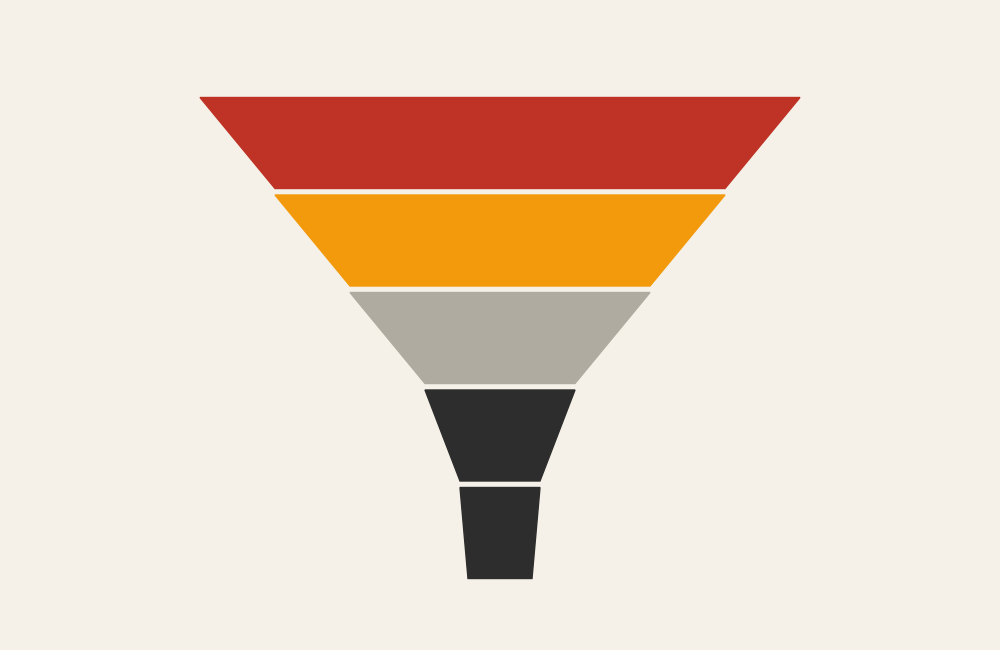
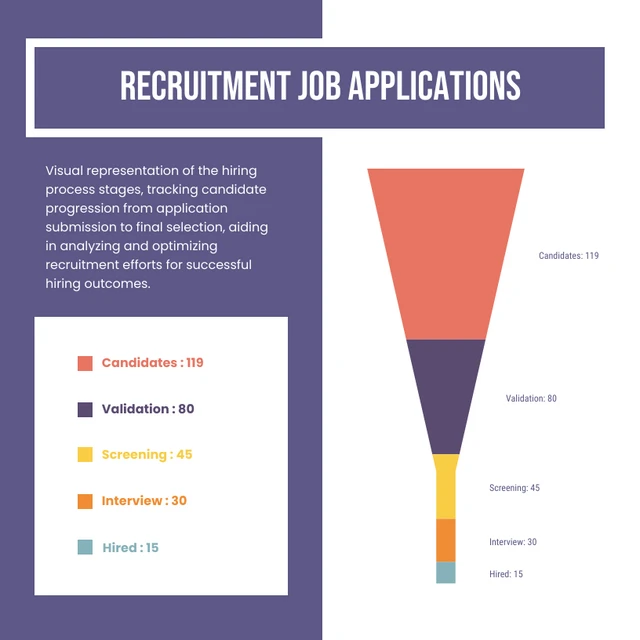
Admissions or Application Review
https://cdn.venngage.com/template/thumbnail/small/277907b0-0e61-4223-a736-c01ac4d27edc.webp

Show how applicants progress from submission to acceptance to enrollment.


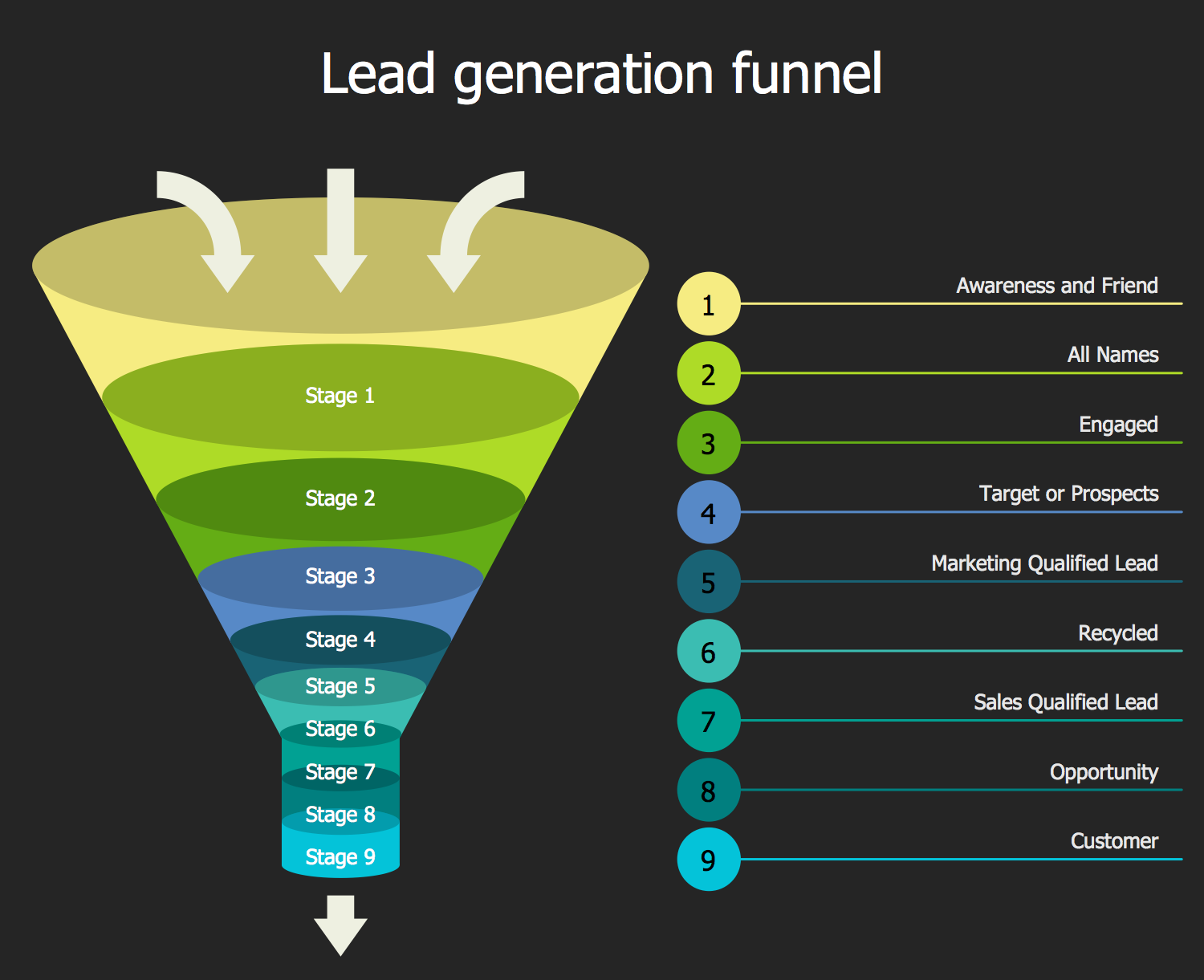
Manufacturing or Quality Control
https://www.conceptdraw.com/solution-park/resource/images/solutions/management-funnel-diagrams/MANAGEMENT-Funnel-Diagram-Lead-Generation-Funnel.png
https://www.spotfire.com/content/dam/spotfire/images/graphics/inforgraphics/funnel-chart-04.png

Reveal how materials or products are filtered through inspection stages.


What to Avoid or Be Careful Of with a Funnel Chart

❌ Don’t use it when stages aren’t sequential
If steps don’t flow in order, the funnel shape creates a false narrative.

❌ Don’t compare unrelated funnels directly
Different funnels often start with different totals. Side-by-side comparison requires careful normalization.

❌ Don’t rely on shape alone
Labels and values are essential. Without them, the chart becomes decorative instead of informative.

❌ Don’t hide conversion rates
Percent drop-off between stages is often more meaningful than raw counts.

❌ Don’t force symmetry
Funnel charts don’t need to be perfectly centered or smooth. Accuracy matters more than aesthetics.


*Content on this page was curated and edited by expert humans with the creative assistance of AI.

  • facebook
  • instagram
  • linkedin

DON'T MISS ANY SPOT-ON TIPS!

We don't spam! You'll only get emails when we post something awesome.
You can unsubscribe at any time.

Check your inbox or spam folder to confirm your subscription.

©2025 | The Comm Spot | By Newbold Communication & Design