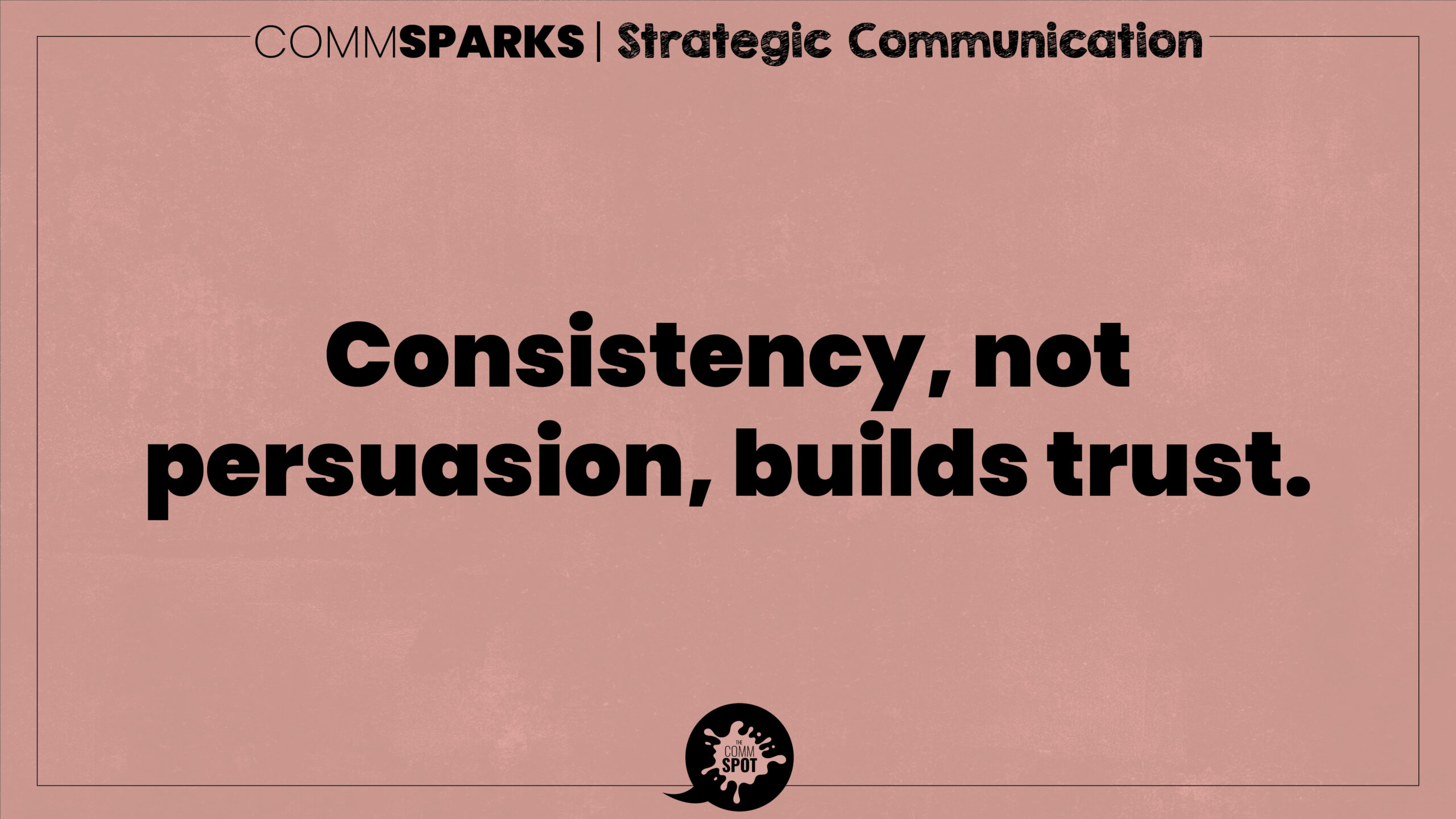
Trust is built less by brilliant messaging than by reliable alignment over time. Persuasion can capture attention in the short term, but trust grows when words, actions, and values repeatedly match. When communication changes tone, standards, or promises depending on the audience or circumstance, people learn to doubt it—even if each individual message sounds convincing. Consistency functions as proof of character and competence. It signals that expectations will hold, commitments will be honored, and information can be relied upon.
Consistency applies to both message and behavior. In organizations, trust grows when policies are applied uniformly and when leaders follow through on stated priorities. In brands, trust grows when voice, promises, and user experience align across channels and over time. In interpersonal contexts, trust grows when boundaries, feedback, and expectations remain stable. Consistency does not mean rigidity; it means coherence. Changes can occur, but they should be explained and grounded in principles rather than appearing arbitrary.
This principle also reframes communication goals. Instead of focusing on “winning” a moment, focus shifts to building credibility that compounds. That credibility makes future communication easier: messages are received with less skepticism and less need for proof. Trust is an asset built through consistency.
Try it!
- Keep promises small but reliable—then scale them.
- Align messages across channels so the story doesn’t change.
- Explain changes explicitly and tie them to stable principles.