

This page contains Amazon affiliate links, which means we may earn a small commission at no additional cost to you if you make a purchase through those links.
Overview / Introduction
Kress and van Leeuwen’s Visual Grammar is a framework for analyzing how images communicate meaning using structures similar to language. Developed in the 1990s by Gunther Kress and Theo van Leeuwen, the theory applies concepts from linguistics—especially Halliday’s Systemic Functional Linguistics (SFL)—to visual communication. It argues that visuals are not neutral; they are designed systems that use grammar-like rules to express relationships, power, emotion, and ideology.
Key Text
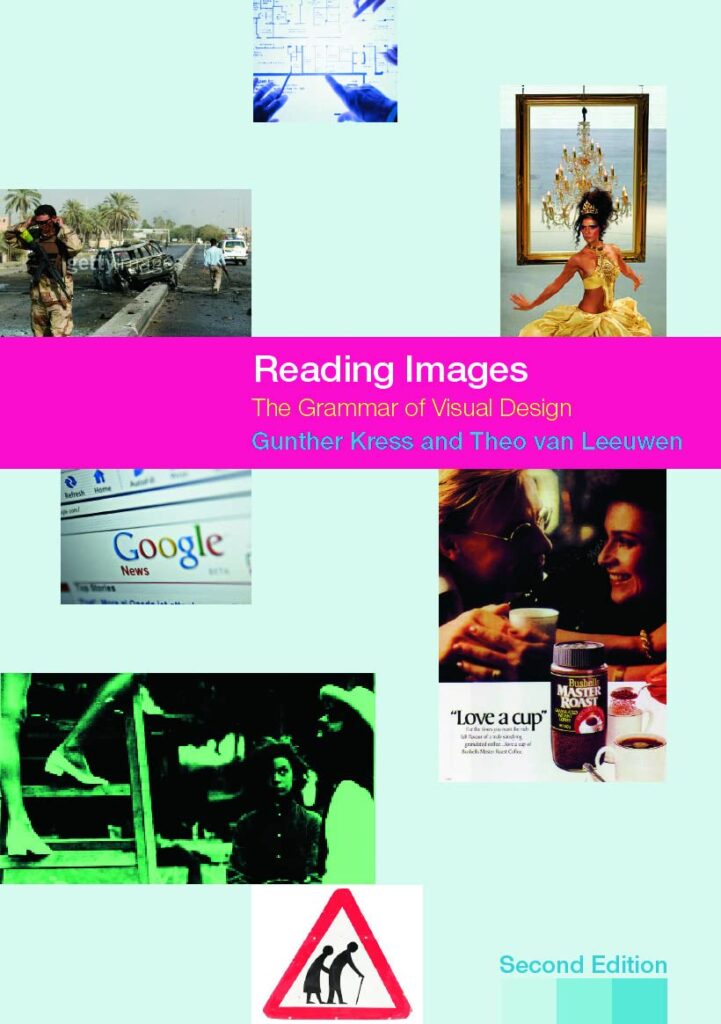
Kress and van Leeuwen’s visual grammar was first developed in their book, Reading Images: The Grammar of Visual Design.
History and Background
Visual Grammar emerged from the growing field of multimodal discourse analysis, which studies how meaning is created through combinations of text, image, sound, and gesture.
- Introduced in Kress and van Leeuwen’s (1996) landmark book Reading Images: The Grammar of Visual Design.
- Built on M. A. K. Halliday’s (1978) idea that language serves three metafunctions: ideational, interpersonal, and textual.
- Adapted these metafunctions to the visual mode—showing how images, like sentences, can “say” things through structure and choice.
- Emerged during the digital age, when visual communication became increasingly dominant in media, advertising, and online discourse.
Visual Grammar bridges linguistics and design, providing a systematic way to decode how images produce meaning and influence interpretation.
Core Concepts
Kress and van Leeuwen’s model translates linguistic metafunctions into visual structures that shape how viewers interpret images.
1. Representational Meaning (Ideational Function)
Concerns what is represented in the image—people, objects, and their relationships.
- Narrative structures depict action, movement, or process (e.g., a person handing an object).
- Conceptual structures show static or classificatory relationships (e.g., a chart, a portrait, or an organizational hierarchy).
These compositions reflect how reality is visually constructed and categorized.
2. Interactive Meaning (Interpersonal Function)
Examines how images engage the viewer and establish social relations.
- Gaze: A direct gaze creates engagement (“demand” image); an indirect gaze invites observation (“offer” image).
- Social Distance: Close-ups suggest intimacy, while long shots create detachment.
- Angle: High angles convey authority or vulnerability; eye-level angles suggest equality.
- Modality: The realism or abstraction of an image conveys levels of truth or objectivity.
Through these cues, visuals position the viewer emotionally and socially—just as tone and pronouns do in language.
3. Compositional Meaning (Textual Function)
Relates to how elements are arranged to form a coherent whole.
- Information Value: Placement gives meaning—left implies “given,” right implies “new,” top signals “ideal,” and bottom shows “real.”
- Salience: Elements draw attention through size, color, focus, and contrast.
- Framing: Boundaries and whitespace separate or connect ideas, signaling relationships.
This visual grammar organizes content to guide reading paths and influence perception, similar to syntax in language.
4. Multimodality
Kress and van Leeuwen emphasize that images rarely stand alone—they combine with text, sound, or layout.
- Meaning arises from interplay across modes.
- For example, an advertisement pairs image, typography, and color palette to create a unified persuasive message.
Applications
Visual Grammar is widely used in media analysis, education, design, and strategic communication to uncover how images encode ideology and emotion.
- Media and Advertising: Reveals how visual choices communicate power, gender roles, and consumer values.
- Public Relations: Analyzes how brand imagery conveys trust, authority, and cultural alignment.
- Political Communication: Studies how visuals construct national identity or political narratives.
- Instructional Design: Informs how diagrams, icons, and visuals communicate effectively in learning materials.
- Journalism and Visual Storytelling: Helps analyze photojournalistic framing, composition, and subject positioning.
- Social Media Analysis: Interprets how selfies, memes, and infographics use gaze and layout to build engagement.
By decoding the grammar of images, communicators can both analyze and design visuals more strategically.
Strengths and Contributions
Kress and van Leeuwen’s Visual Grammar has profoundly shaped the study of visual communication.
- Provides a structured, linguistic framework for analyzing visuals.
- Bridges semiotics, linguistics, and design into a unified theory.
- Encourages critical awareness of how visuals shape ideology and power relations.
- Offers practical tools for media literacy and visual education.
- Anticipates the rise of multimodal communication in the digital age.
The theory empowers communicators to see visuals as intentional meaning systems, not passive decorations.
Criticisms and Limitations
While highly influential, Visual Grammar also faces critical challenges.
- Cultural Specificity: Some visual “grammars” may not translate across cultures.
- Interpretive Variability: Meaning often depends on context and viewer experience.
- Over-Systematization: Critics argue it sometimes imposes rigid structures on fluid visual meaning.
- Technological Change: New visual forms (e.g., motion graphics, AR) stretch the framework’s applicability.
- Empirical Validation: Some concepts lack quantitative support, relying instead on interpretive analysis.
Nonetheless, its explanatory power makes it a cornerstone of visual semiotics and multimodal analysis.
Key Scholars and Works
Kress and van Leeuwen’s framework continues to influence media and design research globally.
- Kress, G., & van Leeuwen, T. (1996). Reading Images: The Grammar of Visual Design. Routledge.
- Kress, G., & van Leeuwen, T. (2001). Multimodal Discourse: The Modes and Media of Contemporary Communication. Arnold Publishers.
- Halliday, M. A. K. (1978). Language as Social Semiotic: The Social Interpretation of Language and Meaning. University Park Press.
- Jewitt, C. (2009). The Routledge Handbook of Multimodal Analysis. Routledge.
- Machin, D. (2014). Visual Communication. De Gruyter Mouton.
- Bateman, J. (2014). Text and Image: A Critical Introduction to the Visual/Verbal Divide. Routledge.
Related Theories
Visual Grammar connects with a range of communication and semiotic frameworks.
- Semiotics (Barthes, Saussure, Peirce): Studies how signs and symbols convey meaning.
- Social Semiotics: Examines meaning-making as a social, cultural process.
- Multimodal Discourse Analysis: Explores how text, image, and sound interact.
- Visual Rhetoric: Focuses on persuasion through imagery.
- Framing Theory: Analyzes how visuals emphasize particular narratives.
- Cultural Studies: Examines power and ideology in media representation.
Together, these theories form the intellectual backbone of modern visual communication scholarship.
Examples and Case Studies
Kress and van Leeuwen’s Visual Grammar is often used to decode images in advertising, politics, and media.
- National Geographic Covers: Use framing and gaze to construct cultural otherness or empathy.
- Political Campaign Posters: Deploy composition and color to suggest leadership, trust, or unity.
- Social Media Influencers: Use interactive meaning (direct gaze, proximity) to simulate intimacy.
- News Photography: Balances representational and compositional meanings to evoke emotional impact.
- Corporate Branding: Combines modality and salience to signal credibility and transparency.
- Public Health Infographics: Use layout and color hierarchy to clarify information and motivate behavior.
Each example shows how images act as structured visual statements, governed by compositional “grammar.”
References and Further Reading
- Kress, G., & van Leeuwen, T. (1996). Reading Images: The Grammar of Visual Design. Routledge.
- Kress, G., & van Leeuwen, T. (2001). Multimodal Discourse: The Modes and Media of Contemporary Communication. Arnold.
- Halliday, M. A. K. (1978). Language as Social Semiotic. University Park Press.
- Jewitt, C. (2009). The Routledge Handbook of Multimodal Analysis. Routledge.
- Machin, D. (2014). Visual Communication. De Gruyter Mouton.
- Bateman, J. (2014). Text and Image: A Critical Introduction to the Visual/Verbal Divide. Routledge.
- van Leeuwen, T. (2005). Introducing Social Semiotics. Routledge.
- Stöckl, H. (2004). “In Between Modes: Language and Image in Printed Media.” Visual Communication, 3(3), 285–325.*
*Content on this page was curated and edited by expert humans with the creative assistance of AI.