
Ignite Better Communication in 60 Seconds a Day
If everything stands out, nothing does.
Emphasis depends on contrast. When every element is bold, colorful, urgent, or highlighted, hierarchy disappears and attention fragments. Audiences rely ...
Consistency, not persuasion, builds trust.
Trust is built less by brilliant messaging than by reliable alignment over time. Persuasion can capture attention in the short ...
Use colons to introduce significance.
A colon is a rhetorical signal: it announces that what follows is a payoff. Unlike a comma, which suggests continuation, ...
“To effectively communicate, we must realize we are all different.” — Tony Robbins
This principle recognizes that communication is filtered through differences in experience, values, knowledge, culture, and cognitive style. A message does ...

Ask before you advise.
Advice often fails because it is delivered before the problem is understood. Without context, advice becomes generic, misapplied, or even ...
End with a takeaway, not a fade-away.
Endings determine what survives. Even strong content can lose impact if it ends without consolidation, direction, or closure. A fade-away ...

Color should communicate, not just decorate.
Color is a meaning system, not a finishing touch. It signals hierarchy (what matters first), category (what belongs together), status ...
Say less, aim more.
Concise communication isn’t about being brief; it’s about being targeted. Length becomes a problem when it reflects uncertainty about purpose—when ...
End sentences with what matters most.
Sentence endings carry natural emphasis. Readers tend to remember what arrives last because it functions as a rhetorical landing point—the ...
“Design is not just what it looks like and feels like. Design is how it works.” — Steve Jobs
This principle shifts attention from aesthetics to function. Design is not primarily decoration; it is a system that shapes understanding ...
Assumptions are silent misunderstandings.
Most workplace problems don’t start with conflict.They start with assumptions. Assumptions are quiet, easy, and usually well-intentioned. They help us ...

Stories stick; data supports.
Stories and data do different jobs, and communication improves when each is used for what it does best. Stories create ...
White space is an active element.
White space structures information and reduces cognitive load. It separates ideas, signals hierarchy, and improves readability. Rather than being empty, ...
When stakes are high, clarity beats cleverness.
High-stakes communication demands precision. In contexts involving safety, policy, crisis, ethics, or accountability, ambiguity introduces risk. Clever language—metaphor, humor, or ...
Vary sentence length for empahsis.
Sentence length shapes rhythm, pacing, and emphasis. Uniform sentence length produces monotony, while intentional variation guides attention and reinforces meaning ...
“The single biggest problem in communication is the illusion that it has taken place.” — George Bernard Shaw
This quote exposes a common misunderstanding: communication feels complete once a message is sent. However, delivery does not guarantee understanding, ...
Listen to understand, not to reload.
Listening is often mistaken for waiting silently while preparing a response. In reality, this approach prioritizes defense or persuasion over ...

Open strong or lose the room.
Openings determine whether attention is granted or withdrawn. Audiences quickly decide whether a message is worth engaging, often within moments ...
Message without audience insight is guesswork
Communication only works when it is shaped by a clear understanding of the people receiving it. Without audience insight, messages ...
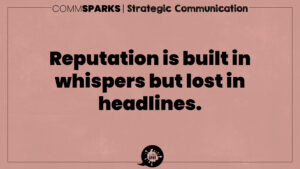
Reputation Is Built in Whispers but Lost in Headlines
Reputation is one of the most fragile and valuable assets any person or organization possesses. It’s built slowly — through ...
