Clout isn’t something we achieve. It’s something we carry with us—into a board room, a salary negotiation, a job interview, a classroom. It’s our presence…as defined by the people around us. And it changes depending on context and purpose.
I’ve thought a lot about this, both in personal and professional spaces. “Clout,” by definition, means influence. It’s the ability to command a room, shape opinions, and direct decisions. We establish clout in a company or an industry by how we are understood—our background, experience, and personal network. Like a brand, it’s something we build and refine, yet we only control it insomuch as we are able to present it to others. If people feel it, they respond to it in ways that tend to be beneficial. Our clout gives us power; it puts us in a position of strength. But it’s only as powerful as it is understood by others.
Thus clout is more than ethos. Credibility and experience can only get us so far. We have to be able to communicate it and display it—not just through words, but through experience, through social proof, and through presence.
Clout isn’t about arrogance or ego. It’s about earned respect, established through a combination of humility, discipline, experience, empathy, and presence. It’s about others seeing the greatest strengths in you during a given situation—not because you’ve broadcasted those strengths, but because they can see them and feel them in you.
If we walk into a job interview, for example, our clout will be partially understood by the résumé that got us invited; depth and breadth of experience will matter, of course. But our clout will also be enhanced by our network and reputation. It will be shaped by who and what we’ve become, by how we’re seen and understood, and how we’re able to present ourselves and build relationships in real time. If our clout is evident, we’re more likely to get the job. If we lack it, we’ll likely struggle to effectively move the conversation toward a job offer.
The point is, we need clout. We need it when we’re managing a team, negotiating a raise, proposing an idea, leading a discussion, or even buying a car (ask me how many times I’ve felt fleeced because I didn’t effectively establish clout before talking to a salesperson). In any given situation in which our ability to influence will matter, our clout is what will make or break the results.
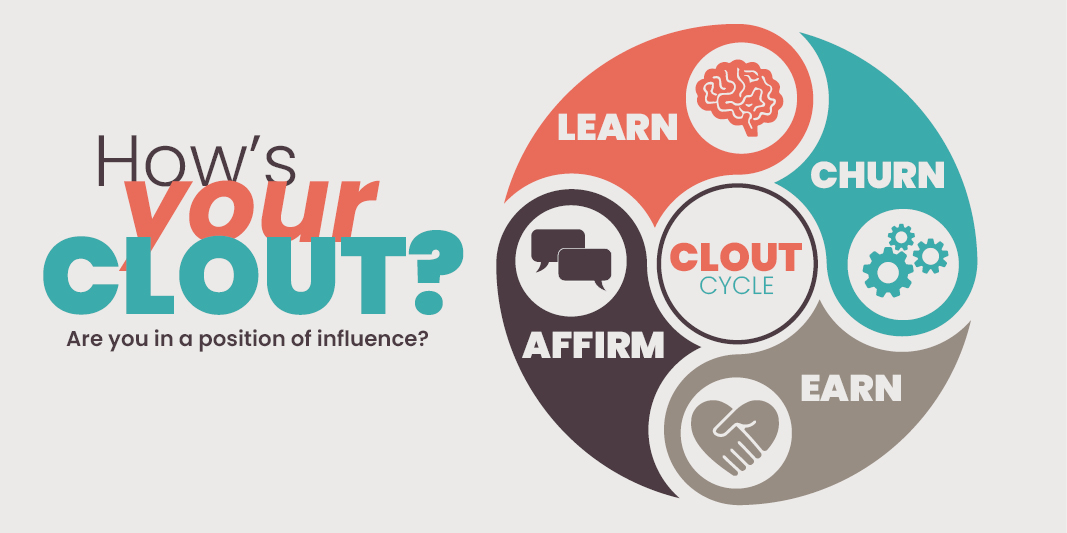
So, how do we build clout? In many ways, it’s a lifelong process that we earn over time as we shape relationships, build networks, increase in experience and wisdom, and learn to adapt in diverse situations. But whether we’re seeking to build our clout long-term within our industry or short-term for our next negotiation, there is a formula we can follow. I like to call this the Clout Cycle: an iterative process in which we’re establishing our position of influence. It includes four parts:
- Learn: Gaining knowledge
- Churn: Putting in the work
- Earn: Building trust and respect
- Affirm: Presenting and communicating ourselves
In the remainder of this post, I provide a few examples of what this looks like in action and how we can build our own clout.
Learn — Soak in as Much as You Can
Learning is the foundation of clout. It’s about continually seeking new knowledge, sharpening your understanding, and turning information into wisdom. Those who learn consistently develop insights that set them apart as thought leaders.
Do this:
- Read widely and curiously, stretching beyond your field and looking to discover connections.
- Seek mentors and role models who challenge and expand your thinking.
- Expect failure and learn from the experience; see mistakes as opportunities for growth.
- Invest in formal and informal education with the mindset of lifelong understanding.
Churn — Try, Fail, Work, and Grind
Churning is the grind — the day-in, day-out effort of putting your skills to work. It’s about taking advantage of opportunities, saying yes to challenges, and accumulating both breadth and depth of experience. Every hour of sweat builds resilience, credibility, and confidence.
Do this:
- Step into projects and experiences that intimidate you; let them stretch your limits.
- Volunteer for work others avoid—tackle problems to build resilience.
- Experiment with new approaches, knowing innovation lives in the grind.
- Document your progress and celebrate milestones as proof of growth.
Earn — Build Trust and Maintain Relationships
Earning clout comes through others — through trust, empathy, and the respect you cultivate. It’s about showing humility, listening more than you speak, and making genuine connections with people from diverse backgrounds. Clout grows when others believe in both your competence and your character.
Do this:
- Listen with intent, making others feel heard and valued.
- Practice humility by giving credit generously and receiving feedback openly.
- Build bridges across differences, seeing diversity as a source of strength.
- Show up consistently with integrity, letting trust compound over time.
Affirm — Communicate and Establish Presence
Affirming is about projecting your credibility through voice, presence, and values. It’s how you communicate clearly, stand with confidence, and amplify your social proof. Affirmation turns silent effort into visible influence.
Do this:
- Align your words and actions so people trust what they see and hear.
- Speak and write with clarity, confidence, and personal touch so your message resonates.
- Build a presence—online and offline—that reflects your values and strengths.
- Share your wins humbly but visibly, inspiring others through your story.