
Skip to content
The Comm Spot The Comm Spot

It's All About Communication

  • HOME
  • ABOUT
    • Meet the Creator: Curtis Newbold, PhD
    • Hire Curtis
    • Publish with Us
    • Contact
    • Privacy Notice
  • COMM-BASICS
    • Glossary
    • Citation & Style Guides
      • AP Style (Journalism)
        • AP Style Overview
        • AP Style Guidelines
        • Media Ethics – SPJ Code of Ethics
        • Elements of Newsworthiness
      • APA Style
        • APA Format – Overview
        • APA - References Guidelines
        • APA - In-text Citations
        • APA - Citing Authors
        • APA - Audiovisual Media
        • APA - Books
        • APA - Digital Sources
        • APA - Events & Interactions
        • APA - Periodicals
        • APA - Print Sources (other than books)
      • Chicago Style
        • Chicago – Overview
        • Chicago - Author-Date System
        • Chicago - Notes-Bibliography System
        • Chicago - In-text Citations
        • Chicago Style - Citing Authors
        • Chicago - Audiovisual Media
        • Chicago - Books
        • Chicago - Digital Sources
        • Chicago - Events and Interactions
        • Chicago - Citing Periodicals
        • Chicago - Print Sources (other than books)
      • MLA Style
        • MLA Overview
        • MLA Works Cited Pages
        • MLA In-text Citations
        • MLA – Authors
        • MLA – Audiovisual Media
        • MLA – Books
        • MLA – Digital Sources
        • MLA – Events & Interactions
        • MLA – Periodicals
        • MLA – Print Sources (other than books)
    • Rhetoric
      • Overview of Rhetoric
      • Rhetorical Appeals (Rhetorical Triangle)
      • Branches of Oratory
      • Canons of Rhetoric
      • Rhetorical Devices
      • Kairos
      • Topos
      • Key Figures in Rhetoric
    • Research Methods
      • Case Studies
      • Competitor Analysis
      • Content Analysis
      • Discourse Analysis
      • Ethnography
      • Focus Groups
      • Observation Research
      • S.W.O.T. Analysis
      • Secondary Research
      • Surveys
      • Target Market Analysis
      • Usability Testing
      • Visual Analysis
    • Theories
    • Thinkers
  • COMM-SUBJECTS
    • Interpersonal Communication
      • Active Listening
      • Body Language
      • Conflict Management
      • Emotional Intelligence
        • Emotional Intelligence Overview
        • Self-Awareness
        • Self-Regulation
        • Motivation
        • Empathy
        • Social Skills
        • Emotional Intelligence Resources
      • Feedback
      • Negotiation
        • Overview of Negotiation
        • Negotiation Skills
        • Negotiation Strategies & Techniques
        • Stages of Negotiation
        • Common Negotiation Scenarios
        • Negotiation Case Studies & Examples
        • Negotiation Tools & Resources
        • Negotiation FAQ
    • Journalism
    • Public Speaking
      • General Guidelines
      • Overcoming Fear
      • Speech Writing and Organization
      • Delivery Techniques
      • Body Language
      • Audience Engagement
      • Storytelling
      • Designing Slides
      • P.O.W.E.R.F.U.L. Presentation Method
    • Strategic Communication
      • Business & Org Comm
        • Definition & History
        • Org Comm Theories
        • Business Documents
        • Change Management
        • Employee Relations
        • Employment Communication
        • Group & Team Communication
        • Leadership Communication
        • Power, Identity, & Ethics at Work
        • Project Management
      • Integrated Marketing Comm
        • Definition of IMC
        • Core Principles of IMC
        • IMC Planning
        • Audience Segmentation
        • Marketing Channels
        • Message Strategies
        • Campaign Measurement & Evaluation
        • Trends & Innovations in IMC
        • Challenges & Pitfalls in IMC
        • Careers & Roles in IMC
      • Public Relations
        • Foundations in PR
        • Strategic Practice
        • Tools & Tactics
        • Research & Analysis
        • Professional Development
      • Case Studies in Strat Comm
    • Technical & Scientific Communication
    • Visual Communication
      • Data Visualization
      • Information Design
      • Photography
      • Web Design
    • Written Communication
      • Writing Process
      • Organizational Methods
        • Five Paragraph Essay
        • Hourglass Method of Writing
        • IMRaD Format (Science)
        • Indirect Method (Bad News)
        • Inverted Pyramid (Journalism)
        • Martini Glass
        • Narrative Format
        • Proposal Format
        • Rogerian Method
        • Toulmin Method
      • Plain Language
        • Audience (Plain Language)
        • Organization (Plain Language)
        • Conversation (Plain Language)
        • Simplicity (Plain Language)
        • Word Choice (Plain Language)
        • Sentence Structure (Plain Language)
        • Design (Plain Language)
      • Punctuation
        • Apostrophes
        • Brackets
        • Colons
        • Commas
        • Ellipses
        • Em Dashes
        • En Dashes
        • Exclamation Marks
        • Hyphens
        • Parentheses
        • Periods
        • Question Marks
        • Quotation Marks
        • Semicolons
      • Style
        • Clarity
        • Conciseness
        • Consistency
        • Editing
        • Flow
        • Rhetorical Devices
        • Sentence Structure
        • Storytelling
        • Tone
        • Voice
        • Word Choice
  • RESOURCES
    • Teaching Resources
      • Assignments & Activities
      • Instructional Design
      • Pedagogies
  • BLOGS
    • The Spotlight Blog
    • Comm Sparks
  • SHOP
    • Cart
    • Checkout
0
The Comm Spot
The Comm Spot

It's All About Communication

Quotation Marks

Home >COMM-Subjects >Written Communication >Punctuation >Quotation Marks

What Are Quotation Marks?

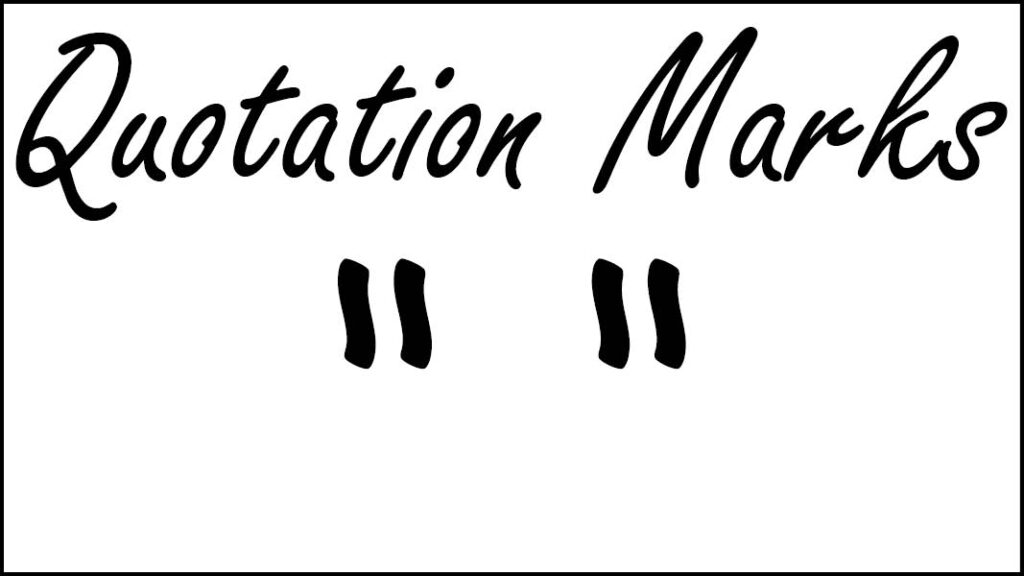
Quotation marks (“ ” or ‘ ’) are punctuation marks used to enclose words or phrases that are being quoted, defined, emphasized, or referenced in a specific way. They are used in dialogue, academic writing, and informal communication to signal that the words inside them have a special significance. Quotation marks help to indicate direct speech, define words, or convey nuance in tone. When used correctly, they clarify meaning and enhance readability.

Examples:

  1. “She said, ‘I’ll meet you at 6 p.m.’” (Double quotation marks for dialogue, single for a quote within a quote.)
  2. “The term ‘photosynthesis’ refers to the process plants use to convert light into energy.”

Learn Next: How to Use Semicolons


The Five Ways to Use Quotation Marks

1. Indicate a Direct Quotation

The most common use of quotation marks is to enclose a direct quote—the exact words spoken or written by someone. This is often used in dialogue, interviews, and research citations.

Examples:

  1. She said, “I can’t wait for the concert!”
  2. The professor explained, “Gravity is a fundamental force of nature.”

What NOT to Do:

  • She said, I can’t wait for the concert! (Without quotation marks, it is unclear where the spoken words begin and end.)

2. Indicate a Dictionary Definition

Quotation marks are used to enclose the definition of a word, particularly in dictionaries or academic writing.

Examples:

  1. The word “ubiquitous” means “present everywhere at once.”
  2. According to the dictionary, “serendipity” is “the occurrence of events by chance in a happy or beneficial way.”

What NOT to Do:

  • The word “ubiquitous” means present everywhere at once. (Without quotation marks around the definition, the sentence lacks clarity.)

3. Indicate Sarcasm or Snarkiness

Quotation marks can be used to imply sarcasm, doubt, or irony, often referred to as scare quotes. This usage suggests that the word or phrase is being questioned or used in an unusual way.

Examples:

  1. She’s a real “expert” at being late. (Implies she is not actually an expert.)
  2. Oh sure, that sounds like a “great” idea. (Indicates sarcasm.)

What NOT to Do:

  • She is a “teacher” at the school. (Unless there is doubt about her being a teacher, the quotes are unnecessary.)

4. Address a Word as a Word

When mentioning a word as itself (rather than using it in a sentence normally), quotation marks help distinguish it from the rest of the text.

Examples:

  1. The word “literally” is often misused.
  2. You should never confuse “affect” and “effect.”

What NOT to Do:

  • The word literally is often misused. (Without quotation marks, “literally” blends into the sentence as a normal word.)

5. Indicate the Title of a Short Media Piece

Quotation marks are used to enclose the titles of short works, such as poems, articles, songs, and short stories.

Examples:

  1. I just read “The Tell-Tale Heart” by Edgar Allan Poe.
  2. Her favorite song is “Bohemian Rhapsody” by Queen.

What NOT to Do:

  • I just read The Tell-Tale Heart by Edgar Allan Poe. (Without quotation marks, it looks like a book title rather than a short story.)

Rhetorical Use of Quotation Marks

Beyond their grammatical functions, quotation marks can be used rhetorically to add humor, skepticism, or subtle critique. Writers sometimes break the traditional rules by using quotation marks in unexpected ways to create emphasis or irony.

When Breaking the Rules Makes Sense:

  1. For Playful or Humorous Effect
    • She’s on a “diet” but just ate three slices of cake. (Suggests she isn’t truly dieting.)
  2. To Make Readers Question a Term
    • He calls himself a “leader,” but I’m not convinced. (Implies doubt about his leadership abilities.)
  3. To Mimic Spoken Gestures (Air Quotes)
    • She said she was “busy,” but I saw her at the mall. (Sarcastically questions her excuse.)

What NOT to Do:

  • This is a “great” opportunity. (If used excessively, scare quotes can make the writing look passive-aggressive or unclear.)

*Content on this page was curated and edited by expert humans with the creative assistance of AI.

  • facebook
  • instagram
  • linkedin

DON'T MISS ANY SPOT-ON TIPS!

We don't spam! You'll only get emails when we post something awesome.
You can unsubscribe at any time.

Check your inbox or spam folder to confirm your subscription.

©2025 | The Comm Spot | By Newbold Communication & Design