
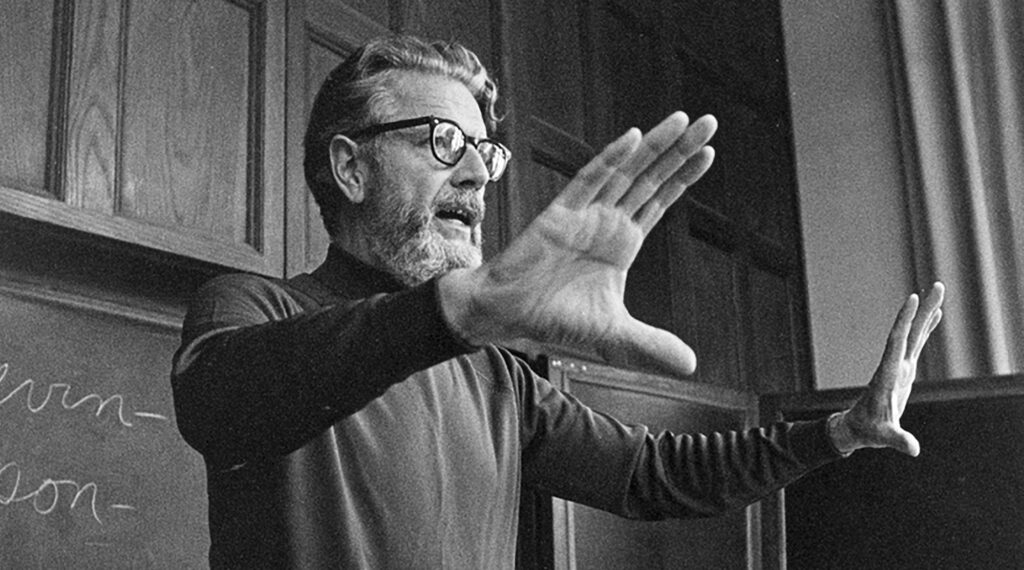
Who Was Wayne Booth?
Wayne C. Booth (1921-2005) was an influential American literary critic and rhetorician, best known for his groundbreaking contributions to the fields of literary theory, criticism, and rhetoric. A longtime professor at the University of Chicago, Booth is celebrated for his works that bridge the gap between the understanding of rhetoric and the analysis of literature. His seminal book, “The Rhetoric of Fiction” (1961), revolutionized the study of narrative techniques and remains a cornerstone in the study of literary criticism.
Booth’s Teachings About Rhetoric
Wayne Booth’s teachings focused on the interconnections between rhetoric, ethics, and the craft of writing. He introduced the concept of the “implied author,” which refers to the author’s persona implied by the narrative voice of a text, distinct from the actual author. This concept helped readers and critics understand the persuasive techniques and ethical positions embedded in literary texts. Booth argued that all writing is rhetorical in that it attempts to persuade readers towards certain interpretations or emotional responses.
In “The Rhetoric of Fiction,” Booth explored how authors use various narrative techniques to create persuasive effects, making a case for the evaluation of narrative art through a rhetorical lens. He extended these ideas further in later works like “Modern Dogma and the Rhetoric of Assent” (1974), where he advocated for rhetoric as a means of honest and ethical communication in everyday discourse, not just in literature.
Booth’s Influence in the Study of Rhetoric and Communication
Booth’s work significantly broadened the understanding of rhetoric beyond traditional speeches and essays to include all forms of written communication, especially literary texts. His emphasis on the ethical responsibilities of authors—and by extension, all communicators—pioneered a more comprehensive approach to studying how texts influence audiences.
Booth’s ideas have permeated various disciplines, including literary studies, philosophy, and the burgeoning field of rhetoric and composition. He was instrumental in fostering a revival of interest in the art of rhetoric not only as a tool for effective communication but also as a critical instrument for ethical persuasion and mutual understanding. Through his teaching and writing, Booth inspired generations of students and scholars to consider the deeper implications of the writer’s ethical stance and the reader’s active role in creating meaning.
*Content on this page was curated and edited by expert humans with the creative assistance of AI.