
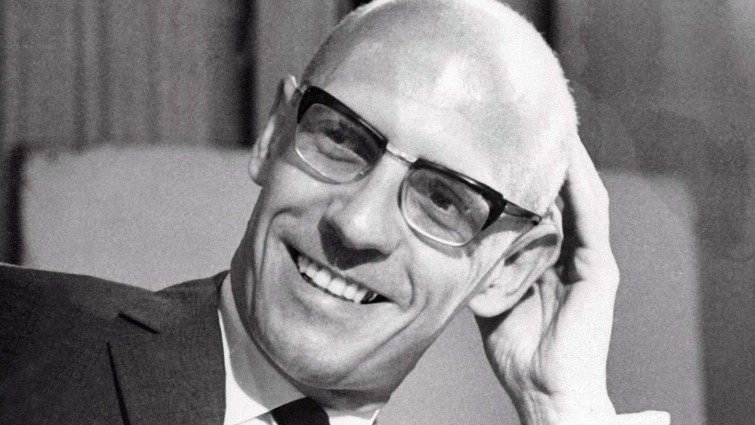
Who Was Michel Foucault?
Michel Foucault (1926-1984) was a French philosopher, social theorist, and historian of ideas, recognized as one of the most influential and controversial thinkers of the 20th century. Foucault’s work explored the complex relationships between power, knowledge, and society. His major works, including Discipline and Punish and The History of Sexuality, critically examine how societal institutions use power to regulate human behavior and thought.
Foucault’s Teachings About Rhetoric
While Michel Foucault did not explicitly focus on rhetoric in the traditional sense, his exploration of discourse is profoundly relevant to rhetorical studies. Foucault developed the concept of discursive formations, or the ways in which knowledge is structured, produced, and distributed through language within specific historical contexts. He argued that discourse is not merely a medium for expressing thought but a form of power that shapes knowledge and, consequently, social practices and identities. Foucault’s analysis of discourse emphasizes the role of language in the exercise of power and the construction of social realities.
Foucault’s Influence in the Study of Rhetoric and Communication
Foucault’s theories challenge traditional notions of rhetoric as simply the art of persuasion, presenting it instead as a central mechanism in the power dynamics of society. Foucault’s ideas have sparked new approaches in rhetorical analysis, particularly in the fields of critical discourse analysis and the rhetoric of science.
Foucault’s work encourages scholars to examine how rhetorical practices are implicated in the maintenance and resistance of power structures. For example, his concept of biopower—the regulation of populations through “an explosion of numerous and diverse techniques for achieving the subjugations of bodies and the control of populations” (The History of Sexuality)—provides a framework for analyzing how public health communications might influence societal norms and behaviors.
In communication studies, Foucault’s theories help analyze how media and cultural texts contribute to the formation of knowledge and identities, offering insights into the ways media can both challenge and perpetuate societal norms and power relations.
*Content on this page was curated and edited by expert humans with the creative assistance of AI.