
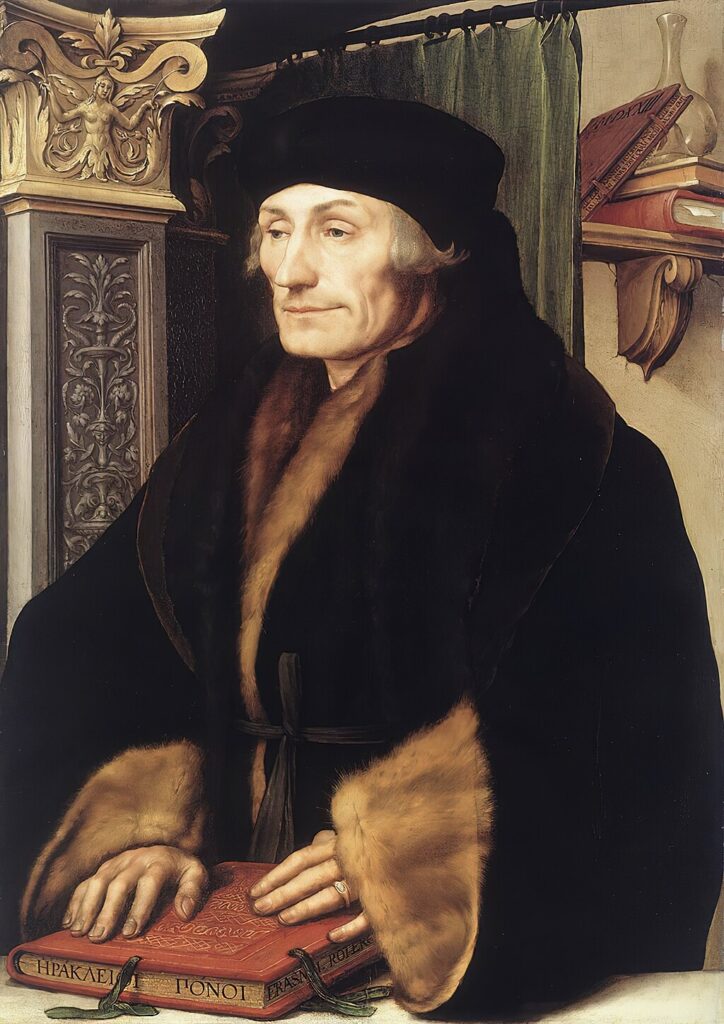
Who Was Erasmus?
Desiderius Erasmus of Rotterdam, born in 1466 in the Netherlands, was a towering figure of the Northern Renaissance. A Dutch philosopher, theologian, and humanist, Erasmus was one of the most influential scholars of his time. He is best known for his critical and scholarly works, including “In Praise of Folly,” “Adages,” and his Greek and Latin editions of the New Testament. Erasmus’ emphasis on education, religious reform, and intellectual inquiry positioned him at the center of the intellectual currents of the Renaissance.
Erasmus’ Teachings on Rhetoric
Erasmus’ contributions to rhetoric are most prominently seen in his work “De Copia: Foundations of the Abundant Style,” a comprehensive guide to rhetorical style and expression. In “De Copia,” Erasmus explored the concept of copia, which refers to the richness and abundance of language. He emphasized the importance of varied and eloquent expression, encouraging writers and speakers to develop a versatile and extensive vocabulary. Erasmus taught that effective rhetoric requires not only stylistic elegance but also intellectual depth and ethical consideration. He believed that rhetoric should be used to convey truth and foster understanding, aligning with the humanist principles of education and moral improvement. Additionally, his “Colloquies,” a collection of dialogues, served as practical exercises in rhetoric, teaching students how to argue, debate, and communicate effectively.
Erasmus’ Influence on the Study of Rhetoric and Communication
Erasmus’ works, particularly “De Copia,” became essential texts in the rhetorical education of the Renaissance and beyond. By emphasizing the richness of language and the importance of stylistic variation, Erasmus helped shape the rhetorical practices of his time, promoting a humanistic approach to education that integrated classical learning with contemporary scholarship. His ideas on the ethical use of rhetoric and the necessity of eloquence and clarity in communication resonated with later educators and rhetoricians. Erasmus’ commitment to using rhetoric for educational and moral purposes influenced subsequent generations of scholars, including figures like Thomas More and Martin Luther, and his legacy continues to inform modern rhetorical theory and practice.
*Content on this page was curated and edited by expert humans with the creative assistance of AI.