
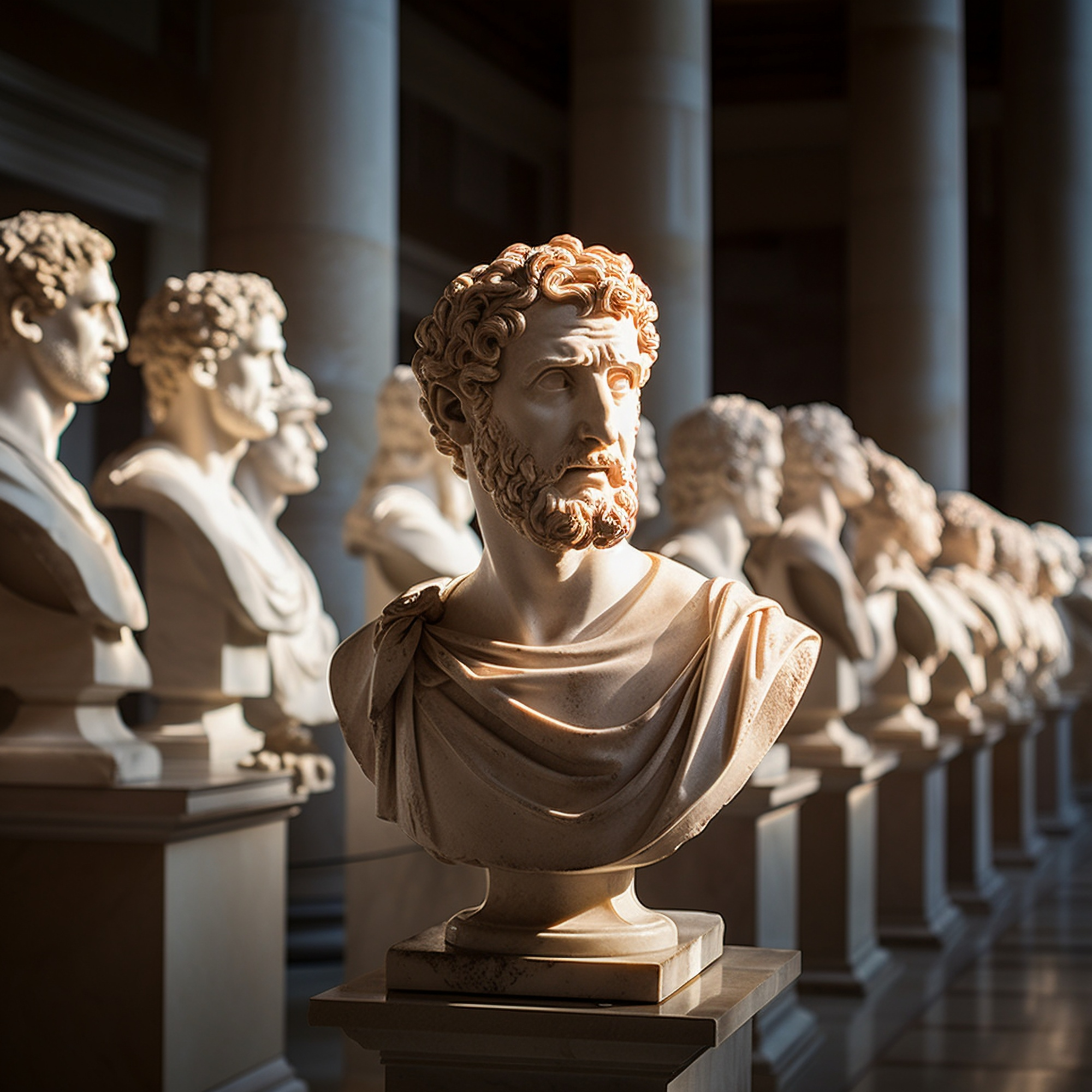
The study and practice of rhetoric has been influenced by many scholars and thinkers throughout history. Below is a short list of some of the central figures historically and today.
Ancient Greek and Roman Figures
- Aristotle (384-322 BCE): Greek philosopher who wrote “Rhetoric,” outlining the three modes of persuasion: ethos, pathos, and logos.
- Cicero (106-43 BCE): Roman statesman and orator whose works, such as “De Oratore,” contributed significantly to the development of rhetorical theory.
- Demosthenes (384-322 BCE): Athenian orator and statesman renowned for his powerful speeches and persuasive oratory.
- Gorgias (c. 483-375 BCE): Sophist and pre-Socratic philosopher known for his rhetorical skill and contributions to the development of sophistry.
- Isocrates (436-338 BCE): Greek rhetorician and educator who emphasized the moral and ethical dimensions of rhetoric in his teachings and writings.
- Plato (c. 428-348 BCE): Greek philosopher who, through dialogues like “Gorgias” and “Phaedrus,” explored the ethical implications of rhetoric.
- Quintilian (c. 35-100 CE): Roman rhetorician known for his work “Institutio Oratoria,” which outlined comprehensive rhetorical education.
- Socrates (c. 470-399 BCE): Classical Greek philosopher whose Socratic method influenced rhetorical questioning and dialogue.
Medieval to Renaissance Figures
- Augustine of Hippo (354-430 CE): Early Christian theologian who integrated rhetorical principles into his theological writings, particularly in “De Doctrina Christiana.”
- Erasmus (1466-1536): Dutch Renaissance humanist and scholar who emphasized the importance of rhetoric in education and intellectual life in works like “De Copia.”
- Francis Bacon (1561-1626): An English philosopher and statesman known for developing the scientific method and for his works on rhetoric and inductive reasoning.
Enlightenment to 19th Century Figures
- John Locke (1632-1704): An English philosopher and physician who contributed to the study of rhetoric and communication through his theories on human understanding and the nature of language, as articulated in “An Essay Concerning Human Understanding.”
- David Hume (1711-1776): A Scottish philosopher and historian whose work on human nature and empiricist approach to knowledge and rhetoric are expressed in his essays and the influential “A Treatise of Human Nature.”
- Hugh Blair (1718-1800): Scottish rhetorician whose “Lectures on Rhetoric and Belles Lettres” influenced rhetorical education in the English-speaking world.
- George Campbell (1719-1796): Scottish philosopher and rhetorician known for “The Philosophy of Rhetoric,” which explored the relationship between rhetoric and human psychology.
- Richard Whately (1787-1863): English rhetorician and logician who wrote “Elements of Rhetoric,” which systematized the study of rhetorical theory and practice.
- Friedrich Nietzsche (1844-1900): German philosopher whose critique of rhetoric and exploration of language’s role in shaping reality influenced modern rhetorical theory.
20th Century Figures
- Walter Benjamin (1892-1940): A German-Jewish philosopher and cultural critic, Benjamin’s essays on the aesthetics of culture, media, and history, especially “The Work of Art in the Age of Mechanical Reproduction,” have had a lasting impact on modern rhetorical and communication studies.
- Kenneth Burke (1897-1993): American literary theorist and rhetorician who introduced concepts such as identification and dramatism in works like “A Rhetoric of Motives.”
- I.A. Richards (1893-1979): English literary critic whose theories on the interplay of language, meaning, and context influenced rhetorical studies.
- Chaim Perelman (1912-1984): Belgian philosopher who, along with Lucie Olbrechts-Tyteca, developed the “new rhetoric” emphasizing argumentation and audience in “The New Rhetoric: A Treatise on Argumentation.”
- Michel Foucault (1926-1984): French philosopher and social theorist whose analysis of discourse and power dynamics contributed to contemporary rhetorical theory.
- Stephen Toulmin (1922-2009): British philosopher who developed the Toulmin Model of Argumentation, which provides a framework for analyzing the structure of arguments.
- Wayne Booth (1921-2005): American literary critic and rhetorician known for his work “The Rhetoric of Fiction,” which explored the role of rhetoric in narrative.
Contemporary Prominent Scholars in Rhetoric*
Below is a shortlist of some of the leading scholars in rhetoric in the 21st Century, organized alphabetically by last name, along with their titles, affiliations, and a brief description of their contributions to the field. **Note that this list is by no means comprehensive; there are many scholars making significant contributions to the study of rhetoric today.
- Title: Chancellor’s Professor of English
- Organization: University of California, Irvine
- Contribution: Focuses on digital rhetoric, sexuality, and composition, exploring how digital environments and identities shape rhetorical practices.
- Title: Wesley Chair of New Media
- Organization: Georgia Institute of Technology
- Contribution: Known for his work on remediation theory and digital rhetoric, examining how new media refashion older media forms.
- Title: Associate Professor of English
- Organization: Northeastern University
- Contribution: Contributes to feminist rhetoric, legal rhetoric, and community-based writing practices.
- Title: Associate Professor of English
- Organization: University of Nevada, Reno
- Contribution: Researches the intersections of rhetoric and economics, analyzing how economic theories influence rhetorical practices.
- Title: Distinguished Professor of French and Theater
- Organization: University of California, Santa Barbara
- Contribution: Specializes in medieval rhetoric and drama, exploring the intersections of rhetorical practices and theatrical performances.
- Title: Liberal Arts Professor of English and Women’s Studies
- Organization: Penn State University
- Contribution: Renowned for her work in feminist rhetoric and rhetorical history, focusing on the roles of women in rhetoric and the importance of silence and listening.
- Title: McCourtney Professor of Civic Deliberation and Professor of English and Communication Arts and Sciences
- Organization: Penn State University
- Contribution: Researches classical rhetoric, rhetorical theory, and the rhetoric of the body, linking ancient practices to contemporary understandings.
- Title: Professor Emeritus of English
- Organization: University of California, Los Angeles
- Contribution: Explores the “rhetoric of the electronic age,” analyzing how digital media transform rhetorical practices.
- Title: Professor Emerita of English
- Organization: Stanford University
- Contribution: Prominent for her work in composition and rhetoric, collaborative writing, rhetorical theory, and digital rhetoric.
- Title: President’s Professor of Rhetoric
- Organization: Loyola Marymount University
- Contribution: Known for rhetorical hermeneutics and the interplay between rhetoric, culture, and interpretation.
- Title: Professor of English
- Organization: Purdue University
- Contribution: Known for his work on ambient rhetoric and the intersections of rhetoric, technology, and culture.
- Title: Chair and Professor of English
- Organization: Arizona State University
- Contribution: Developed the concept of “rhetorical listening,” emphasizing understanding and engagement across differences.
- Title: Associate Professor of Writing and Rhetoric
- Organization: Syracuse University
- Contribution: Focuses on feminist rhetoric, composition, and community literacy, examining how writing functions in community and activist settings.
- Title: Professor of English
- Organization: Penn State University
- Contribution: Specializes in rhetorical theory and writing pedagogy, contributing to understanding writing processes and rhetoric in professional and technical communication.
- Title: Dean of Ivan Allen College of Liberal Arts
- Organization: Georgia Institute of Technology
- Contribution: Known for her work on African American rhetoric and feminist rhetorical practices.
- Title: Regents Professor and Director of the Writing Program
- Organization: Washington State University
- Contribution: Focuses on rhetoric and composition, critical race theory, and the intersections of rhetoric, identity, and social justice.
- Title: Professor of Rhetoric and Writing
- Organization: University of Texas at Austin
- Contribution: Specializes in classical rhetoric and its influence on contemporary rhetorical theory and practices.